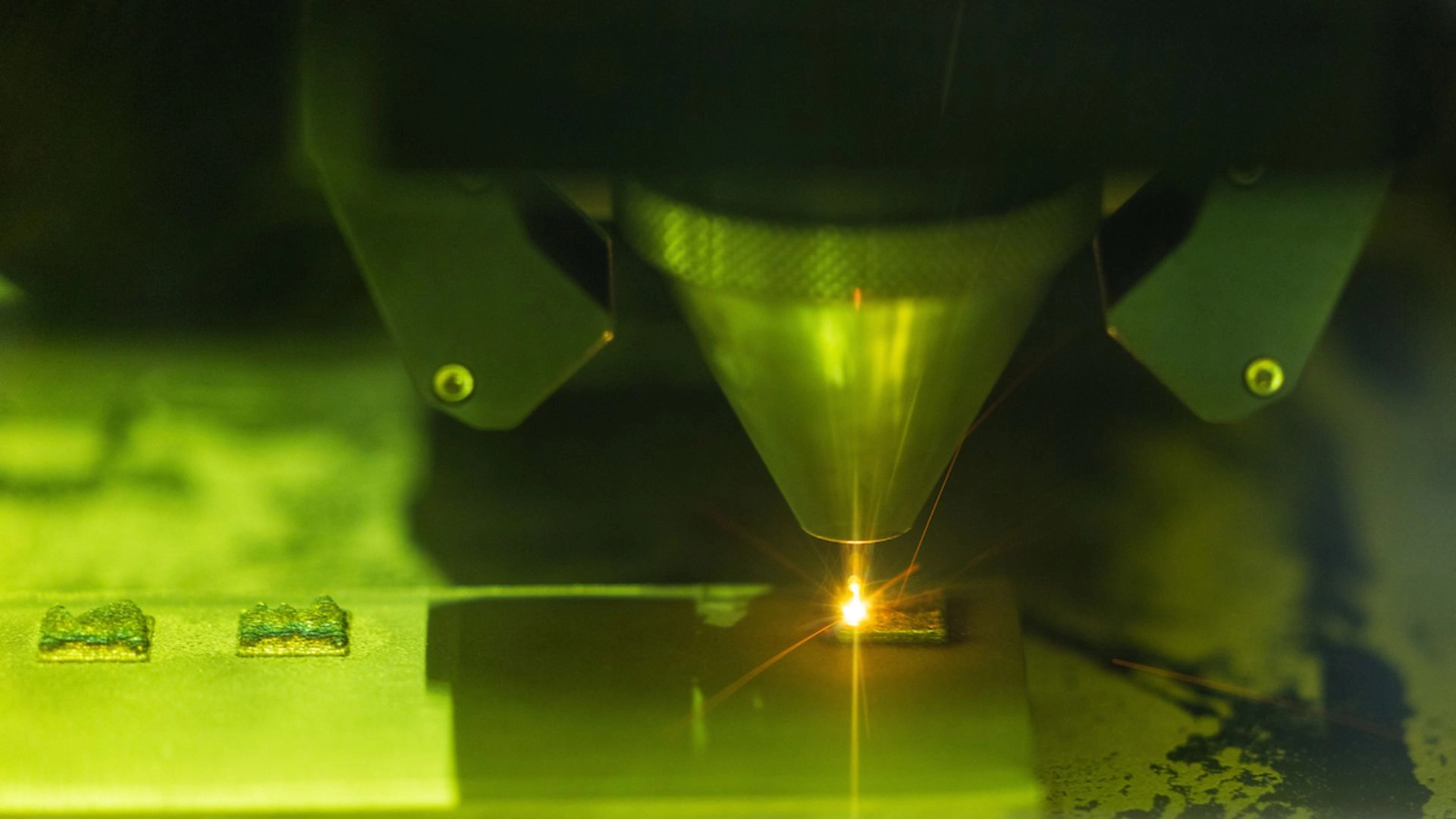
Tungsten is known for its hardness, but its brittleness and the challenges it poses in manufacturing processes can complicate its use. However, 3D printing provides a more straightforward solution for working with this material.
A 3D printer in action at Sougata Roy’s laboratory.
The University of Iowa, in partnership with the Department of Energy (DOE), has initiated the DREAM TEAM project, which aims to leverage 3D printing technology to produce heat-resistant shields made of tungsten for nuclear reactors.
DREAM TEAM is an acronym for Developing a Robust Ecosystem for Additive Manufacturing of Tungsten for Extreme Applications and Management.
Growing apprehensions regarding carbon emissions, along with the goal of achieving net-zero emissions in the upcoming decades, have brought nuclear energy into focus as a viable source of carbon-free power.
Nuclear fission generates one of the largest amounts of clean energy in the United States. According to estimates from the US Energy Information Administration, nuclear fission accounts for 19 percent of the electricity supply, whereas wind energy contributes merely 10 percent to the overall energy mix.
In a bid to advance nuclear fusion technology, the Department of Energy (DOE) has formed an exceptional group known as the DREAM TEAM.
This team is spearheaded by Sougata Roy, an assistant professor of mechanical engineering at the University of Iowa, alongside Yachao Wang, another assistant professor of mechanical engineering from the University of North Dakota, along with researchers hailing from three national laboratories under the DOE: Ames National Laboratory, Argonne National Laboratory, and Oak Ridge National Laboratory.
Roy contributes his knowledge in additive manufacturing, commonly recognized as 3D printing, to the group. His focus will be on creating heat shields and parts intended for deployment within nuclear reactors.
Despite his prior work not being in the realm of clean energy, Roy is enthusiastic about this opportunity. “One of the major things that excites me about this project is working with nuclear energy. This emission-free electricity is important for the future,” Roy expressed in a statement.
The DREAM TEAM initiative is a component of the Department of Energy’s Established Program to Stimulate Competitive Research (EPSCoR), aimed at enhancing the United States’ energy-related capabilities.
Within the DREAM TEAM, scientists will focus on tungsten, a favored material for the internal structures of nuclear reactors due to its elevated melting point and ability to endure extreme temperatures. Additionally, it is a preferred choice for the walls of fusion reactors owing to its resilience against erosion when exposed to neutron radiation and its minimal retention of radioactive tritium.
However, tungsten poses challenges as it is tough yet brittle, making it hard to incorporate into production techniques.
To tackle this, the team, spearheaded by Roy, will employ a laser powder-blown directed energy deposition method for 3D printing tungsten. This innovative strategy involves utilizing a laser in an oxygen-controlled environment to layer tungsten metal onto the walls of nuclear reactors.
A grant of $1 million allocated for the project will allow the team to acquire the necessary equipment for analyzing and characterizing the mechanical properties of the 3D-printed samples. Researcher Roy is particularly enthusiastic about physics-based modeling and computational simulations, which are essential to conduct prior to the 3D printing process.
The team plans to formulate theories from their experimental results by leveraging machine learning and artificial intelligence. However, their focus on tungsten is merely the starting point.
“Our initial material will be pure tungsten,” Roy mentioned in a press release. “Ultimately, we aim to create new alloys that address the issue of cracking.”
For the latest updates on engineering, technology, space, and science, follow The Blueprint.
By clicking sign up, you confirm that you accept this site’s Terms of Use and Privacy Policy
Ameya Paleja Ameya is a science writer residing in Hyderabad, India. With a background in Molecular Biology, he transitioned from using micropipettes to exploring science writing during the pandemic and has no intentions of returning. His interests lie in genetics, microbes, technology, and public policy.
20 hours ago
21 hours ago
21 hours ago
a day ago