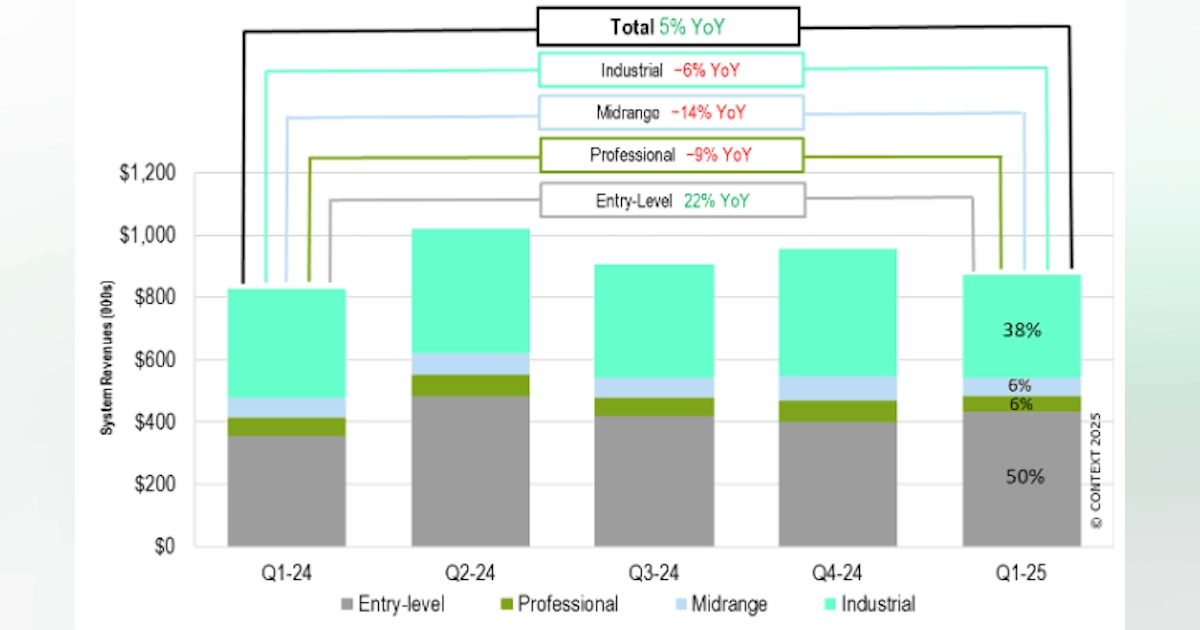
The global 3D printer market is experiencing notable divergence as it heads into 2025, as discussed in a recent report from Context, a market intelligence firm. This analysis highlights how external factors, including tariff disputes, inflation, and rising interest rates, have reshaped market dynamics.
Key Trends in Q1 2025
Growth in Entry-Level Printers
One of the most significant findings is a 15% year-on-year increase in shipments of entry-level 3D printers, which are priced below $2,500. This surge is attributed to consumers and channel partners making preemptive purchases in anticipation of tariffs on imports from China. These affordable systems cater to a wide range of applications, making them ideal for engineers who want to incorporate rapid prototyping into their processes without incurring heavy costs.
Challenges for Industrial and Mid-Range Sectors
In contrast, the industrial and mid-range 3D printer sectors are facing considerable challenges, with shipments plummeting by 14% and 16%, respectively. This downturn is largely due to constrained capital spending influenced by high interest rates. While industrial revenues saw an overall decline of 6% year-on-year, average selling prices for advanced Metal Powder Bed Fusion (PBF) systems helped mitigate some of the losses, especially for major vendors like Eplus3D and Nikon SLM Solutions.
Diverse Trends in Professional Printer Technologies
The professional printer segment, which encompasses systems ranging from $2,500 to $20,000, is also witnessing a shift in technology preferences. Demand for material extrusion technologies (FDM/FFF) has declined significantly—down 31% year-on-year—while vat photopolymerization technologies are thriving, posting a 19% growth due to innovative contributions from companies like Formlabs and SprintRay. These advancements provide mechanical engineers with enhanced precision and finish quality necessary for intricate designs.
Future Outlook
The economic climate remains precarious going into 2025, leading to cautious projections for the market, especially for higher-end 3D printing systems. Recovery from these economic challenges is anticipated to be slow, with more substantial improvements expected by 2026. Despite the economic headwinds, there is still a strong underlying demand for industrial systems. Many Original Equipment Manufacturers (OEMs) are concentrating on profitability over expansion, demonstrating continued customer interest.
"While the immediate forecast remains difficult, a strong demand exists, particularly for industrial systems," noted a representative from Context. "OEMs are positioned for growth once economic conditions stabilize. A gradual recovery could commence in 2026 as interest rates decrease, prompting increased capital expenditure, similar to the rebound experienced after the Covid lockdowns."
For more details, visit Context’s analysis.