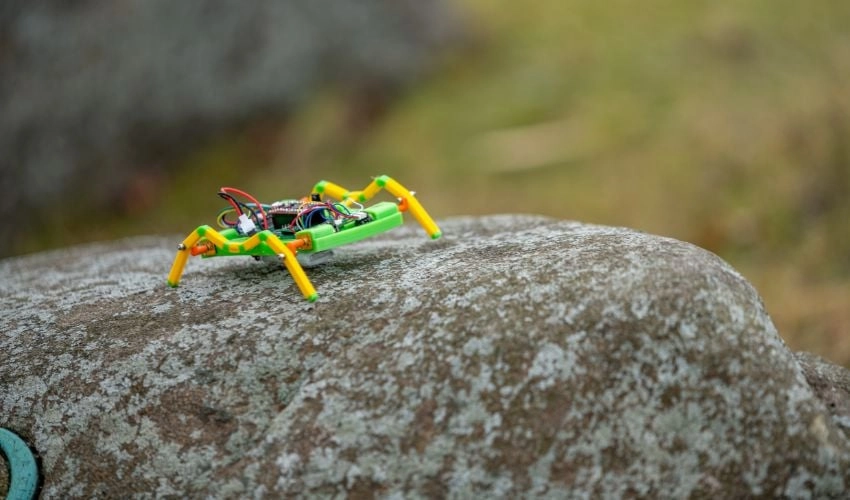
Dr. Markus Nemitz, an Assistant Professor of Mechanical Engineering at Tufts University, is at the forefront of integrating 3D printing into swarm robotics. His research combines his expertise in swarm robotics from his PhD studies and soft robotics from his postdoctoral work at Harvard. Nemitz’s group focuses on rapidly designing, fabricating, and deploying robots, particularly those that employ multi-materials and fluidic circuits. Their goals range from developing underwater vehicles to legged robots, operating under a "single-click" manufacturing process enhanced by machine learning for real-time monitoring and adaptive control.
His fascination with swarm robotics stems from the simplicity of individual agents collaborating to execute complex tasks, inspired by nature’s collective intelligence found in ant colonies and bird flocks. This approach could revolutionize numerous critical applications, including large-area searches, earthquake rescue operations, environmental monitoring, and planetary exploration. The challenges lie in producing large numbers of inexpensive yet robust robots, a hurdle that Nemitz is gradually overcoming through innovative 3D printing techniques.
3D printing, particularly fused filament fabrication (FFF), emerged as the optimal solution for Nemitz’s research. It allows for quick iterations and the seamless integration of soft and rigid components in a single manufacturing step—a feat traditional methods cannot achieve efficiently. By utilizing a few types of filament with different material properties, his group can autonomously create complex robotic systems, which minimizes human error and enhances scalability.
The team employs multi-material fused deposition modeling (FDM) and fused granulate fabrication (FGF) for their projects. These processes provide precise control over mechanical properties and enable the embedding of components mid-print, which is essential for functionality. FGF is particularly effective, allowing the fabrication of elastomeric materials with properties akin to silicone while maintaining cost-effectiveness and sustainability.
Soft robotics forms the backbone of Nemitz’s projects, as these robots made from flexible materials can absorb impacts and adapt to various conditions, mirroring the resilience found in biological systems. Nemitz envisions that future robotics will inherently combine soft and rigid materials, leveraging the advantages of both. This multi-material approach simplifies production without requiring extensive assembly, significantly affecting the speed and cost of robot deployment.
Currently, Nemitz’s projects are advancing from prototypes to field-ready systems. One notable example is a proof-of-concept legged robot that merges the advantages of soft and stiff robots, enabling fast movement over difficult terrains. The research extends to integrating fluidic controls, allowing the robots to function dynamically without relying on cumbersome electronics.
A significant focus is also on addressing explosive ordnance disposal (EOD). With over 110 million active landmines posing danger across numerous countries, Nemitz’s work on a 3D-printed EOD robot aims to make demining efforts safer and more efficient. His team has successfully deployed robots in field tests, including a collaboration with a military contractor to detect landmines buried up to one meter deep.
Looking to the future, Nemitz’s research group has received funding to develop crab-inspired robots suited for aerial deployment and amphibious operations, further enriching his ongoing commitment to creating low-cost, scalable robots for various humanitarian applications.
Nemitz’s forward-thinking approach and innovations in 3D printing and swarm robotics paint a promising picture for the future of robotics in addressing global issues, from disaster response to demining efforts.