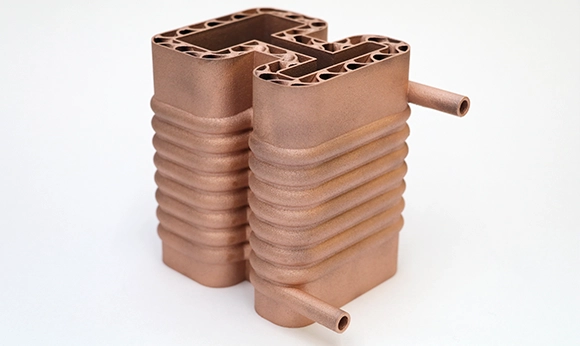
On September 23, 2024, a groundbreaking study was conducted by researchers at the University of Wolverhampton, working alongside the UK Astronomy Technology Centre and Diamond Light Source. Their research focused on enhancing synchrotron absorbers through Copper Additive Manufacturing, pushing the boundaries of 3D printing to increase the efficiency and effectiveness of synchrotron system components.
Copper’s superior thermal and electrical properties make it ideal for key industries like electrified transportation and sustainable manufacturing. Despite these advantages, the complexities involved in processing copper with Laser Beam Powder Bed Fusion have hindered its widespread use in metal additive manufacturing. This new collaboration aims to address these issues and expand the use of this technology.
The University of Wolverhampton’s Centre for Engineering Innovation and Research has been pioneering in PBF-LB technology since 1999. They played a crucial role in the redesign of synchrotron absorbers, utilizing EOS M290 AM machines to incorporate advanced features such as conformal cooling channels and gyroid structures. These enhancements are essential for better thermal management and material efficiency.
Preliminary assessments are indicating significant progress. The updated absorber parts showed a decline in temperature by up to 20%, a reduction in weight by 80%, and a streamlining of components from 21 to just one. These enhancements not only boost the absorber’s efficacy but also streamline its production process.
Professor Arun Arjunan, Director of the Elite Centre for Manufacturing Skills (ECMS), underscored the importance of these developments, saying, “This venture underlines the potential of Additive Manufacturing in thermal management applications. Our team is focused on pushing forward with innovative approaches to fulfill the increasing needs for competent thermal management systems in various sectors.”
Although the prototype versions have demonstrated impressive outcomes, extensive studies and evaluations are scheduled to perfect the design comprehensively. Considering there are around 30,000 accelerators and 60 synchrotrons globally, numerous systems could benefit from a component overhaul through additive manufacturing. The implementation of copper 3D printing might revolutionize the production of these parts and elevate their efficiency.
Detailed findings regarding the thermal efficiency and material characteristics will be elaborated in an imminent research publication, offering deeper insights into copper AM’s tangible benefits in the scientific arena.
This breakthrough in 3D printing technology, focusing on copper, reflects a progressive method toward enhancing thermal management and the performance of components. This advancement may establish new benchmarks for upcoming synchrotron systems.
Source: metal-am.com
The convergence of AI with 3D printing is revolutionizing the approach to creative projects, especially in design-centric professions. This integration of automated technologies continues to expand possibilities… read more »
MIT engineers are delving into the use of 3D-printed glass bricks for eco-friendly building practices. Drawing inspiration from the idea of circular construction, these groundbreaking glass… read more »
The QIDI Plus4 3D Printer is a consumer-grade, large-format 3D printer equipped with second-generation active chamber heating.
Amerimix, a division of Oldcastle APG, a CRH Company, has announced the successful use of its 3D Printing Mortar Mix in the construction… read more »
Mosaic Manufacturing Ltd. has raised $28 million CAD in growth equity financing to expand the production of its innovative 3D printers. This funding,… read more »
The United States Marine Corps, in collaboration with the Naval Air Systems Command’s (NAVAIR), has made a significant advancement by introducing the first… read more »
HeyGears has formed a strategic partnership with Pac-Dent, a company with over three decades of expertise in dental manufacturing. This joint effort seeks to provide… read more »
A company in Southern California is utilizing 3D printing technology to create affordable housing from waste plastic.
Orbital Composites has received a Tactical Funding Increase (TACFI) contract from AFWERX to enhance and expand the production of its Starfighter X modular… read more »
Kawasaki Robotics has launched Astorino, a new educational robotics platform designed to equip industrial and technical education providers with practical experience in programming… read more »