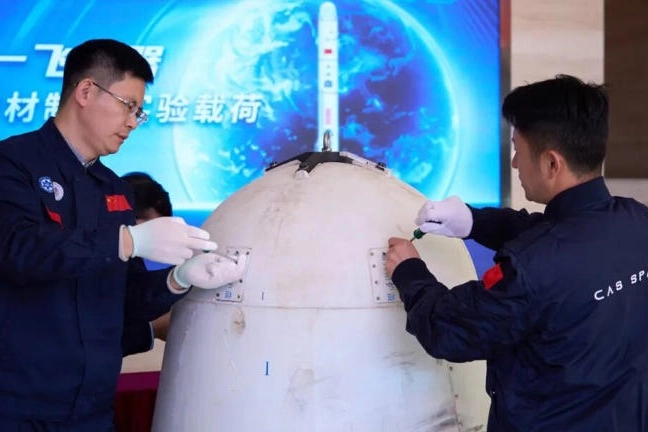
China has achieved a significant milestone by conducting its first metal 3D printing experiment in space. This groundbreaking experiment was executed by a scientific payload developed by the Institute of Mechanics under the Chinese Academy of Sciences (CAS).
The payload was launched aboard the Lihong-1 Y1 suborbital vehicle, a commercial spacecraft designed for space tourism, which successfully took off from the Jiuquan Satellite Launch Center on January 12. Once the vehicle crossed the Karman line, reaching an altitude of around 120 kilometers, it autonomously manufactured metal components in a microgravity environment.
The success of this experiment indicates a pivotal shift for China’s metal additive manufacturing technology, evolving from ground-based research to in-space engineering verification. This advancement positions China at the forefront of global technology in this field.
Conducting metal additive manufacturing in space presents unique challenges compared to Earth, including stable material transport and forming under microgravity, comprehensive control throughout the process, and reliable coordination between the payload and the launch vehicle. The research team successfully navigated these challenges.
After the experiment, the payload capsule made a safe parachute-assisted landing and was quickly recovered, providing scientists with invaluable data on various aspects, including melt pool dynamics, material transport, solidification behavior, and the precision and strength of the printed parts.
The Lihong-1 Y1 vehicle, recognized for its cost-effectiveness and adaptability, also carried rose seeds for an agricultural research initiative. Future developments aim to enhance the spacecraft’s capabilities for crew life support and improve safety technologies, potentially expanding the scope for cost-effective scientific experiments and commercial space tourism.
For more information, visit the CAS page on the China Daily.