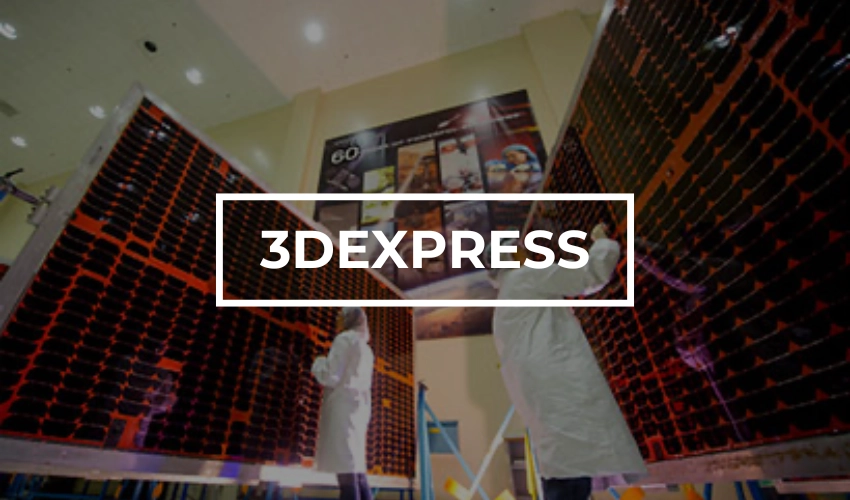
Boeing has recently announced an advancement in satellite technology through the adoption of 3D printing for solar array substrates, effectively cutting production time by up to 50%. This innovative step means that the build time will be reduced by as much as six months compared to traditional manufacturing techniques. The first of these printed solar arrays will be utilized in small satellites developed by Millennium Space Systems, integrating high-efficiency solar cells from Spectrolab.
This collaborative effort involves Boeing’s Space Mission Systems division, which aims to streamline manufacturing processes and reduce complexity in the production chain. By directly incorporating key structural features—such as harness paths and attachment points—into the solar array panels, Boeing minimizes the number of parts needed and eliminates several tooling steps. This not only simplifies assembly and enhances the overall robustness of the systems but also improves performance, reliability, and scalability across various satellite platforms, including the Boeing 702-class spacecraft. The market launch of these advancements is anticipated in 2026. Boeing has already integrated more than 150,000 3D printed components across its aerospace and satellite initiatives, illustrating the potential of additive manufacturing to revolutionize the industry.
Melissa Orme, Boeing’s vice president of Materials & Structures, emphasized the significance of scaling additive manufacturing within the company, stating, “As we scale additive manufacturing across Boeing, we’re not just taking time and cost out, we’re putting performance in.” With qualified materials and a shared digital infrastructure, Boeing aims to produce lighter structures, innovative designs, and greater manufacturing capacity for future projects.
In addition to Boeing’s developments, other noteworthy news includes research from Oak Ridge National Laboratory (ORNL) that explores ceramic additive manufacturing for chemical reactors. The researchers successfully combined binder jetting with advanced post-processing to create ceramic components that are impermeable to liquids, a critical advantage for extreme conditions typical in chemical reactions. This novel approach helps bridge the performance benefits of ceramics with scalable manufacturing processes, making it applicable for future reactor technologies.
Furthermore, Meltio, in collaboration with its US distributor Fastech, is set to unveil its first metal additive manufacturing center in Virginia. This facility aims to cater to industries such as defense, aerospace, and automotive, enabling rapid production of metal parts using Meltio’s Blue Laser technology.
Lastly, the Global AM Hubs Summit took place in Barcelona, attracting 26 additive manufacturing hubs from various countries to foster collaboration and innovation in the field. This event underscored the growing commitment to integrating additive manufacturing within European manufacturing practices.
Overall, these advancements reflect a significant trend towards the application of 3D printing technologies across industries, heralding a new era of efficiency and creativity in manufacturing.
For further details on related innovations and events, you can explore additional topics in Aerospace and Defense.