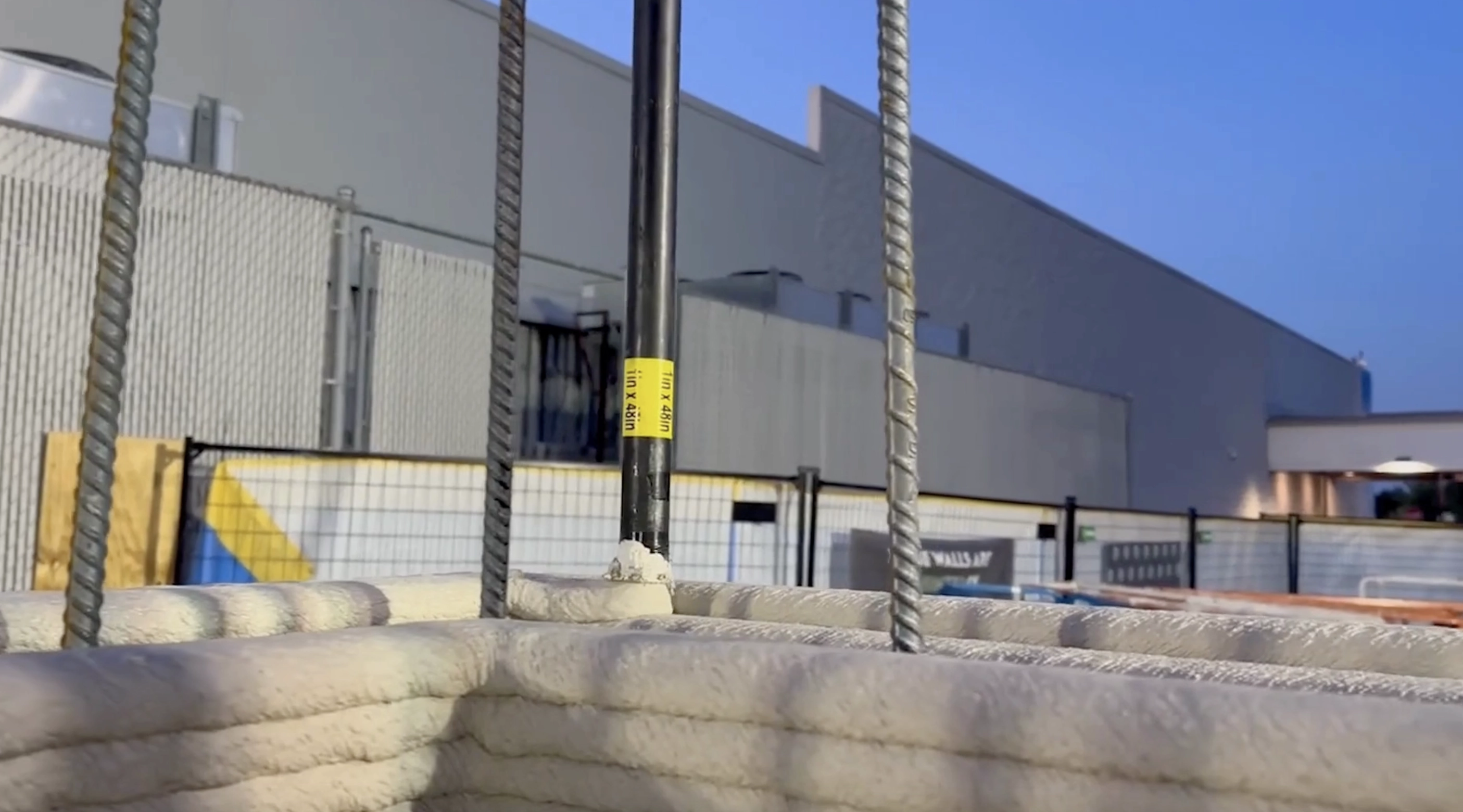
The 8,000-sf, 20-foot-high addition to a Walmart store in Tennessee, which will be used for online pickup and delivery, represents the first application of 3D printing technology by the retailer on such a large scale.
Walmart has unveiled what is among the largest free-standing, 3D-printed commercial buildings in the US. Alquist 3D was responsible for printing the nearly 8,000-sf, 20-foot-high extension at a Walmart location in Athens, Tenn.
This new section, dedicated to facilitating online orders and their pickup, marks a pioneering move by Walmart in using 3D printing technology extensively. The structural design was crafted by CPH, and FMGI served as the general contractor.
“This is the first facility of its kind and it’s simply remarkable that it has been realized. It will significantly contribute to the progress of 3DCP [3D concrete printing] technology,” stated Zachary Mannheimer, founder and chairman of Alquist 3D, during a press release.
After evaluating various enterprises specializing in advanced construction technology, Walmart chose Alquist 3D for its proven capability to manage intricate projects and its collaborations with key industry figures like SIKA, a company specializing in specialty chemicals, and RIC Technology, which provides construction robotics. These alliances equipped Alquist with the necessary expertise and resources to tackle the project’s demands.
“Walmart aims to innovate and harness emerging technologies, and we explored numerous modern construction techniques and firms for this initiative,” stated Mike Neill, vice president of new construction at Walmart. “Alquist showed the greatest capability to collaborate due to their extensive understanding of 3D materials and robotics, and their eagerness to manage a challenging and distinctive project.”
Walmart’s adoption of 3D construction printing is part of its larger objective to enhance environmental sustainability, utilize state-of-the-art technology to draw customers, and hasten the construction process.
The team at Alquist 3D has learned crucial lessons from their latest project, including optimal management of material temperatures during hot seasons, improving the speed of printing, and the implementation of vertical structures up to 20 feet high, marking a new achievement for them. These experiences will guide their future endeavors in both residential and commercial building projects.
“This project’s insights will propel our efforts forward in constructing residential buildings, aligning with Alquist’s vision,” commented Patrick Callahan, CEO of Alquist 3D. “We chose to undertake the most demanding challenge we could and succeeded with outstanding results.”
Alquist and Walmart are set to collaborate on another upcoming project soon.
Researchers at ETH Zurich in Switzerland have crafted a novel robotic additive manufacturing technique aimed at enhancing sustainability in the construction sector. This innovative method does not utilize cement, setting it apart from traditional concrete 3D printing.
Printed Farms, known for completing Florida’s first permitted 3D-printed house in Tallahassee, proudly announces the completion of what is considered the world’s largest 3D-printed building: a luxury horse barn.
This groundbreaking project is expected to propel a significant architectural revolution across the nation.
This week, the architectural and construction industries witnessed a remarkable achievement with the completion of the world’s first 3D-printed medical center in Thailand.
A recent report titled “2023 State of Design & Make” conducted by the software developer Autodesk reveals substantial insights for the design and construction industry. A survey targeting leaders across architecture, engineering, construction, product design, manufacturing, and entertainment sectors highlights a significant endorsement of enhancing sustainability practices within organizations to boost business efficiency.
The University of Michigan’s DART Laboratory has recently introduced Shell Wall, recognized as the first 3D printed, structurally reinforced lightweight concrete wall. This novel creation utilizes advanced research from the DART Laboratory in reducing concrete usage through 3D printing technologies.
Pam Campbell from COOKFOX and Mo Wright from Gate Precast explored the application of 3D-printed molds provided by Oak Ridge National Lab to craft unitized window panels for the One South First, a mixed-use skyscraper located in Brooklyn, N.Y.
Mancini has strategized growth by developing technological tools that enhance client engagement and showcase the firm’s innovative work.
The construction of the building was accomplished using a COBOD BOD2 printer.
The Fibonacci House, named after the medieval Italian mathematician Leonardo Fibonacci, exemplifies the capabilities of 3D Concrete Printing (3DCP) by showing how intricate designs and logistical challenges can be addressed with thoughtful planning and advanced technology.
At ETH Zurich, a Swiss academic institution, researchers have innovated a new robotic additive manufacturing method, which is distinct as it omits the use of cement, making it a greener alternative for the building sector.
Printed Farms, which previously completed the first permitted 3D-printed house in Florida at Tallahassee, now proudly presents the completion of the world’s largest 3D-printed structure: an opulent horse barn.
The construction of a 3D-printed temple marks the beginning of an architectural transformation in the nation.
3D construction printing achieved a groundbreaking milestone recently with the completion of the world’s first 3D-printed medical center in Thailand.