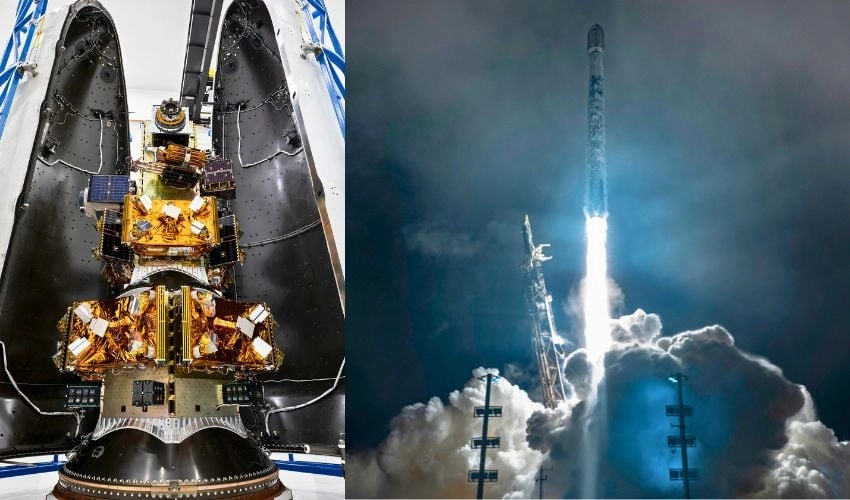
SpaceX recently launched its first Twilight rideshare mission, which includes a vital experiment focused on in-space 3D printing. This mission lifted off on January 11, 2026, from Vandenberg Space Force Base, sending 40 small payloads into a unique dawn–dusk sun-synchronous orbit, where satellites maintain a position between day and night on Earth.
One of the mission’s key payloads is ARAQYS-D1, created by Dcubed, a company specializing in deployable space structures and in-space manufacturing. Instead of sending a pre-assembled component, the mission aims to manufacture a 60-centimeter boom directly in space using additive manufacturing techniques. Following a successful deployment, Dcubed announced that ARAQYS-D1 entered a commissioning phase to prepare for its manufacturing process. The mission is crucial for validating technologies that could enable future power generation in space.
This experiment intends to challenge traditional spacecraft design constraints, which require large structures to be folded and stored during launch. By creating components in orbit, Dcubed hopes to streamline design and potentially overcome the limitations imposed by current Earth-based manufacturing methods.
While 3D printing has previously been tested on the International Space Station—demonstrating processes like bioprinting and metal part production—missions like ARAQYS-D1 signify a shift towards operational testing that aims for repeatable results in orbit. With improved access to rideshare launches, the mission demonstrates how arrangements can support a larger number of small satellite experiments.
Beyond the 3D printing objectives, the Twilight mission also includes the Pandora satellite designed by NASA for studying exoplanets, along with additional CubeSat missions supported by NASA, focusing on Earth observation and IoT connectivity.
As additive manufacturing technologies advance, their application in space is becoming more viable. The focus is now not just on whether 3D printing can function in microgravity, but on how effectively it can be utilized and integrated into future space missions. With innovations like ARAQYS-D1, in-space manufacturing is transitioning from theoretical discussions to practical applications.
For further details on SpaceX rideshare missions, visit the related sections on 3D printing in aerospace and defense and additive manufacturing technologies.