Additive manufacturing is revolutionizing the maritime industry by providing innovative solutions for sustainable practices. A standout example is the Italian startup Velettrica, which has leveraged 3D printing technology to design key components for the SAIL-POD 25 sailboat engine. Through a conversation with founder Roberto Baffigo, insights into the startup’s mission and the applications of 3D printing within their development process have emerged.
Roberto Baffigo, a lifelong sports enthusiast and a physics graduate, found his connection to 3D printing through the jewelry sector, where he experienced the transition from manual to digital prototyping. This technology later facilitated the rapid testing of various inventions for Velettrica’s unique propeller.
Founded in 2021, Velettrica was born out of Baffigo’s desire to explore eco-friendly sailing with his family. The company’s mission is to create energy-efficient propulsion systems powered mainly by renewable sources to minimize marine pollution. The SAIL-POD 25 engine stands at the heart of this initiative, featuring an innovative, biomimetic propeller inspired by the fins of whale sharks. This propeller design allows it to close into a flower shape when not in use, thereby reducing water resistance and optimizing efficiency.
In production, 3D printing has been critical for multiple components of the SAIL-POD 25. Some parts were directly manufactured via 3D printing techniques, while others served as molds or cores for composite creation. The SAIL-POD 25 system is noted for its practical installation requirements, compact design, and pollution-free operation, producing no noise, vibration, or heat.
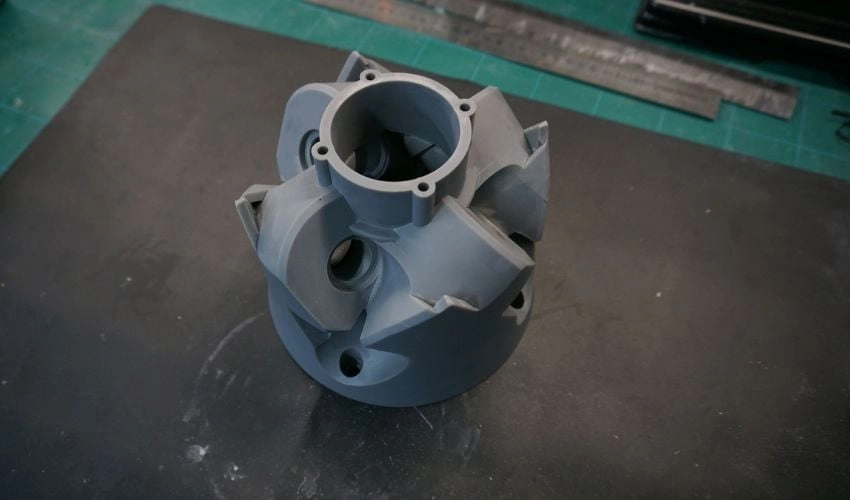
Velettrica utilized various advanced materials and printing technologies in collaboration with firms like 3DiTALY. Components like the propeller blades’ cores were made using a SLS printer, highlighting durability and minimal water absorption, while the complex shape of the propeller hub was achieved with high-detail SLA techniques. Additionally, specialized mechanical parts were crafted from Inconel or aluminum using DMLS technology.
Choosing 3D printing was essential for Velettrica due to the complex design of their systems, which traditional manufacturing methods couldn’t efficiently produce. The advantages of 3D printing included rapid prototyping, significant cost reductions, and the ability to create intricate parts tailored to specific needs. These benefits, coupled with the environmental sustainability of the materials used, align perfectly with Velettrica’s mission.
Looking towards the future, the role of additive manufacturing in the maritime sector is anticipated to grow, particularly in customizing propulsion components while reducing material waste and fostering recycling. Baffigo and Velettrica aspire to extend their innovations to new realms, aiming to utilize similar sustainable principles in aviation next.
In closing, Baffigo encourages readers to embrace 3D printing as a means of transforming their ideas into tangible realities, emphasizing its potential to realize dreams through technology.