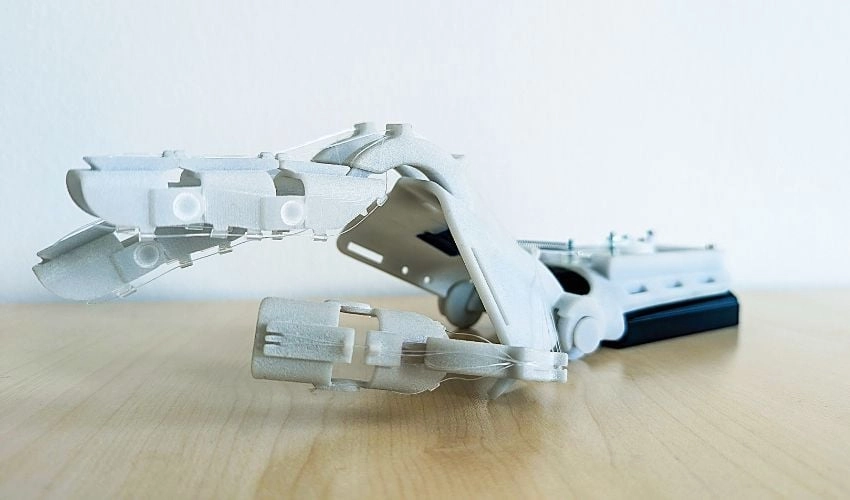
After sustaining injuries that damage tendons, patients often experience significant mobility challenges. Hand injuries, in particular, can require extensive healing time, typically necessitating physiotherapy for full recovery. In response to this need, healthcare professionals are increasingly utilizing exoskeletons designed specifically to support hand and finger movements during rehabilitation. The Fraunhofer IWU has recently developed a tailor-made exoskeleton that leverages the precision of 3D printing technologies.
This innovative exoskeleton incorporates advanced shape-memory alloys, stepper motors, and 3D printing technology. The design requires a perfect fit for each patient’s hand, which is crucial as an ill-fitting exoskeleton can hinder rather than help the healing process. Thanks to additive manufacturing, the structure of the exoskeleton can be customized to meet individual patient needs, presenting a near-limitless ability to create tailored solutions.
The Technology Behind the 3D-Printed Exoskeleton
The team implemented Selective Laser Sintering (SLS) technology, which constructs components layer by layer from a plastic powder. Initially, a digital scan of the patient’s hand is performed, allowing for accurate adjustments in the design process. A parametric CAD model of the exoskeleton is then layered over this scan to ensure precise customization to the patient’s unique dimensions.
This customizable approach allows for modifications during rehabilitation, particularly for patients like children who may still be growing. Additionally, the use of 3D printing means that the exoskeletons are lightweight and easier to wear.
Tailored Support with Artificial Tendons
In addition to anatomical customization, the exoskeleton’s design considers the varying grip strength of each patient. Individuals have differing levels of hand strength, making it essential to adjust the exoskeleton’s force and range of motion accordingly. The researchers utilize a bidirectional stepper motor alongside wires made from shape-memory alloys, functioning as artificial "tendons" that the motor controls with precision. There is even the option for manual fine-tuning of movements when necessary.
In practical applications, the exoskeleton aims to assist patients recovering from tendon injuries as well as those recovering from strokes or paralysis. One significant benefit is its efficiency in clinical environments where therapists may not have the capacity to engage in all necessary therapy exercises. The exoskeleton can facilitate automated exercises with the help of its motors, reducing the dependency on a therapist’s constant presence. More details can be found here.
What are your thoughts on this customizable exoskeleton? Share your views in the comments or connect with us on LinkedIn or Facebook. Stay updated by subscribing to our free weekly Newsletter for the latest in 3D printing. For more information about medical and dental applications of 3D printing, visit our dedicated page here.