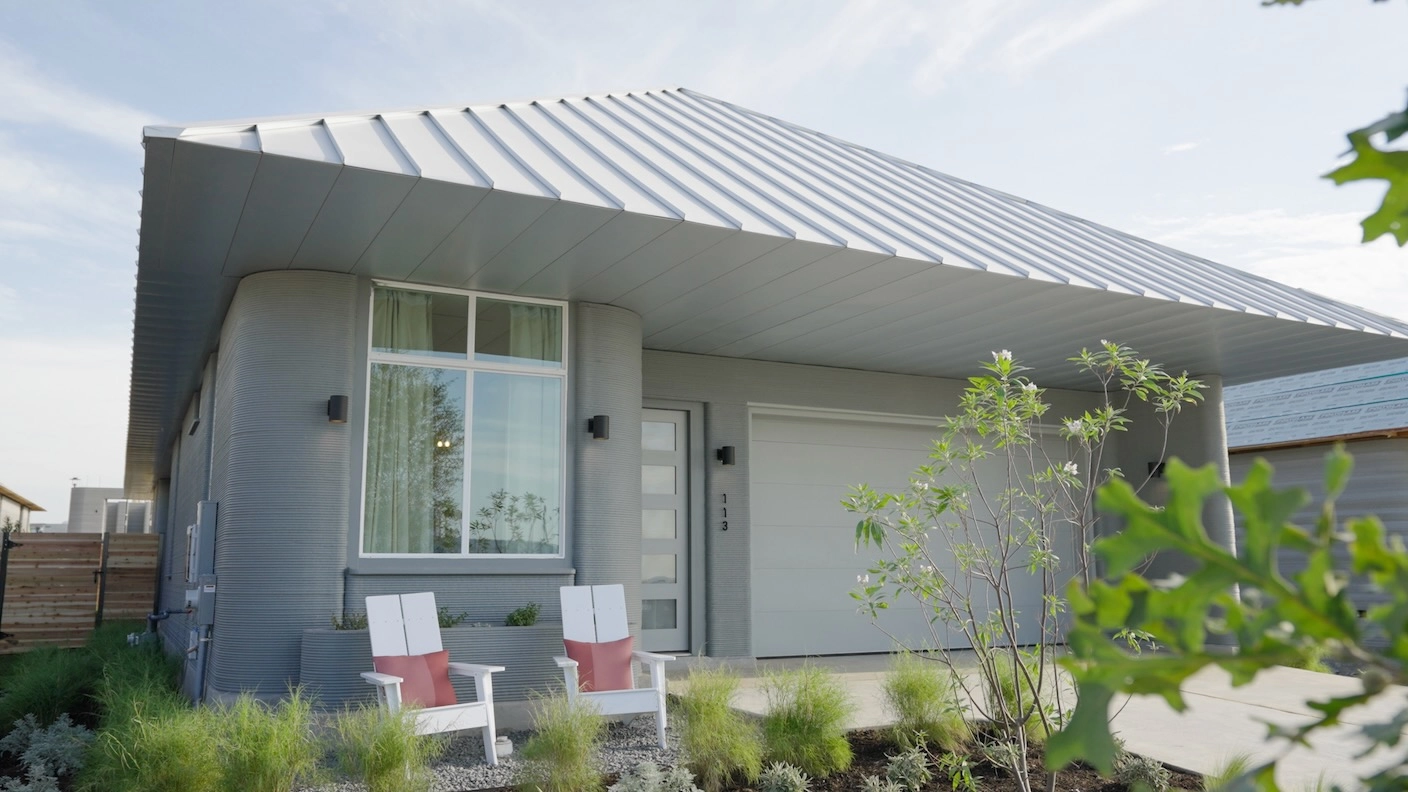
In November 2022, a pioneering venture between Icon and Lennar began with the aim of constructing a 3D printed residential area in Texas. As of a recent report by Reuters, this ambitious project comprising 100 homes is now nearing its completion stage.
The construction technique utilized by Icon involved traditional methods for laying the foundations, roofing, and finishes, while employing their innovative Vulcan 3D printer to erect the walls. The Vulcan printer operates via a crane-like arm featuring a nozzle that meticulously extrudes concrete layers, guided by a digital blueprint, to form the base and subsequently the entire wall structure layer by layer.
As one of the largest undertakings in the emerging field of 3D-printed construction, this project displays the speed and efficiency of this technology; a house can be printed roughly within three weeks using Vulcan, with just a minimal crew. The development features eight distinct ranch-style floor plans, designed in collaboration with Bjark Ingels Group, and offers homes varying from 1,574 to 2,112 square feet with three to four bedrooms.
About a quarter of these homes have been sold, commanding prices between $450,000 and $600,000, which aligns with the region’s average. New homeowners have begun to settle in, with one couple remarking on the sturdiness of the construction and the excellent thermal insulation provided by the thick concrete walls, crucial for the warm Texas climate. Each home includes solar panels, yet a notable minor inconvenience is that the dense concrete material impedes WiFi signals, making a mesh network essential for internet connectivity.
The concept of 3D printing homes is not a novelty. The initial experiments started around the beginning of the 21st century. Companies like Icon have been refining this technology over time, improving concrete materials, robotic delivery methods, and determining what aspects are most effectively achieved through 3D printing.
More recently, this technology has transitioned into commercial applications. In 2021, a house constructed by SQ4D was marketed in New York. Mighty Buildings, a company focused on 3D printing that started with manufacturing and selling prefabricated ADUs, secured $52 million in funding last year. Currently, it is aiming at broader projects including full-scale buildings and communities. Unlike Icon, Mighty fabricates its buildings in segments at a factory which are then transported and assembled on site.
3D printing is acclaimed for being cost-effective, speedy, and less demanding in terms of resources for construction. Advocates believe it can provide more affordable homes to those in need. Toward this goal, Icon has collaborated with New Story to build 3D printed housing in Mexico for families living in serious poverty and with Mobile Loaves & Fishes to construct homes in Austin for the chronically homeless.
So far, the market pricing of commercially 3D-printed houses hasn’t shown a substantial difference from traditional home construction costs. Although certain processes may be less expensive, other aspects, like integrating windows or custom fittings suitable for modern construction technologies into unconventional 3D designs might escalate costs. Besides the building expenses, the market prices also hinge on demand and what buyers are prepared to spend.
To bring costs down, Icon announced Initiative 99 in 2023, a challenge to design 3D-printed homes that can be constructed for less than $99,000. They announced winners for Phase I of the competition at this year’s SXSW.
It’s still the beginning stages for 3D printing as a viable homebuilding technology. The project in Texas is one of the early large-scale attempts, and costs might still drop as Icon and others learn to fine-tune the process and integrate their work within the existing built environment.
In the meantime, a group of Texans will move into their innovative homes—protected by walls made of ridged concrete to shield against the intense heat.