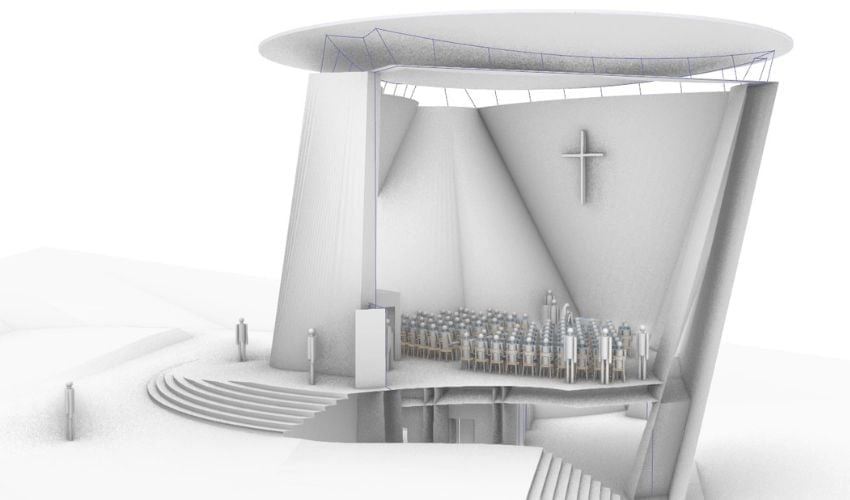
In the Czech city of Liberec, a remarkable project is underway to construct a new church using 3D printing technology. This initiative has been inspired by the historical context of the original Church of Christ, which was built in 1864 but was demolished during the Communist era in 1976 after suffering severe fire damage.
The visionary behind this modern reconstruction is architect Jiří Suchomel, who emphasizes blending tradition with contemporary design. Working alongside teams from the Technical University of Liberec and the Klokner Institute of Prague, Suchomel has developed a mobile 3D printer, “Printing Mantis,” which will be utilized to create the church’s structure.
The new church aims to represent a bridge between past and present, featuring an innovative design that aligns with 21st-century aesthetics. Suchomel’s plan includes a four-story building that can accommodate 100 attendees. The interior is designed for optimal acoustics for both liturgical use and cultural events, while the structure itself will be crafted from 3D-printed concrete accented with a steel and wood roof.
Distinctively planned, the church will be constructed in stages, as the personalized printer allows for the creation of different floors sequentially. Utilization of 3D printing promises to be efficient in terms of time and resources, producing hollow walls that minimize cement use and reduce waste, thus lowering the building’s carbon footprint.
To date, a symbolic fragment of the church has already been produced, but the project’s realization hinges on securing adequate funding. Should financial support be attained, Liberec could become the home of the world’s first fully 3D-printed church. For more insights into this groundbreaking project, you can explore additional details here.
This ambitious undertaking not only seeks to revive the spirit of community worship in Liberec but also paves the way for innovative construction methods that could resonate throughout the architectural landscape.