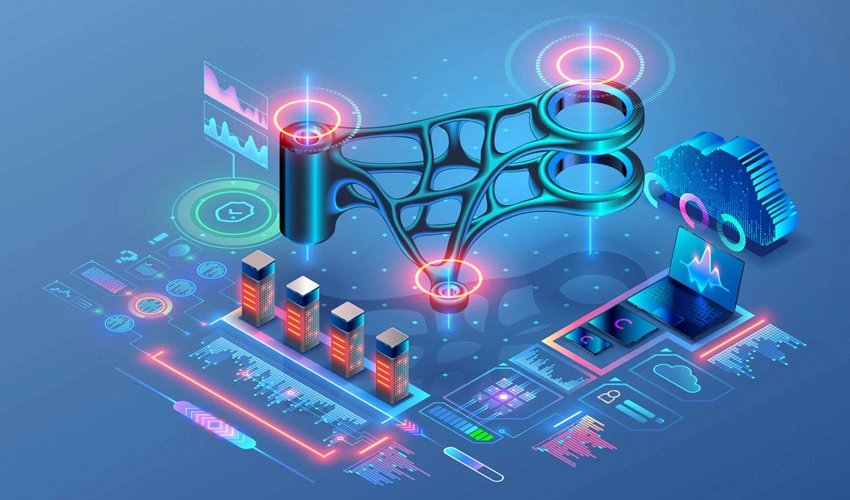
Artificial intelligence (AI) is significantly impacting various industrial sectors, including additive manufacturing, commonly known as 3D printing. By enhancing automation, optimizing production parameters, predicting potential failures, and improving the final product quality, AI applications in 3D printing are broadening and refining. This integration fosters increased operational efficiency, lowers error rates, cuts costs, and shortens production timelines.
Here are several ways AI contributes value to the 3D printing process:
-
Conversion of Sketches to 3D Models: AI simplifies the transition from 2D sketches to 3D models by using computer vision algorithms that recognize and interpret drawings, significantly speeding up the design phase.
-
Design Optimization and Modification: AI can enhance existing 3D models through generative design processes, optimizing for various parameters such as strength and weight, leading to improved product performance and reduced material wastage.
-
Error Recognition and Correction in STL Models: AI algorithms can automatically scan files for design errors that may not be apparent at first glance, facilitating corrections without human input, which is crucial when dealing with complex designs.
-
Intelligent Support and Infill Generation: AI optimizes the placement of supports and the density of infills based on the part’s geometry and intended function. This efficiency minimizes material usage and enhances print quality.
-
Predictive Simulation Before Printing: By simulating various factors before a print job, AI can predict issues related to thermal deformations or internal stress, allowing users to adjust parameters in advance to avoid failures.
-
Real-Time Monitoring to Detect Errors: AI-enhanced cameras can monitor printing processes in real time, identifying problems like warping or jamming. The system can alert operators or take corrective actions automatically.
-
Predictive Printer Maintenance: Sensors combined with AI monitor printer behavior over time, helping to predict maintenance needs before they lead to failures, thus minimizing downtime in continuous operation scenarios.
-
Automatic Classification of Defective Parts: Through vision systems, AI can inspect produced parts for defects such as cracks or layer misalignment, ensuring quality control and separating faulty items from successful prints.
-
Optimizing Post-Processing: AI can streamline the post-processing phase by analyzing part geometry and determining the most effective sequence of actions and tools necessary, thereby enhancing workflow.
-
Intelligent Traceability of Parts: AI assists in tracing the origins of 3D printed components by identifying unique microscopic characteristics, which helps in quality assurance and counterfeit prevention.
The integration of AI into 3D printing processes presents a transformative potential, enhancing everything from initial design to quality checks, making the entire manufacturing process smarter and more efficient.
For more information on the applications of AI in 3D printing, you can explore these topics: AI Softwares in 3D Printing and 3D Printing Problems and Solutions.