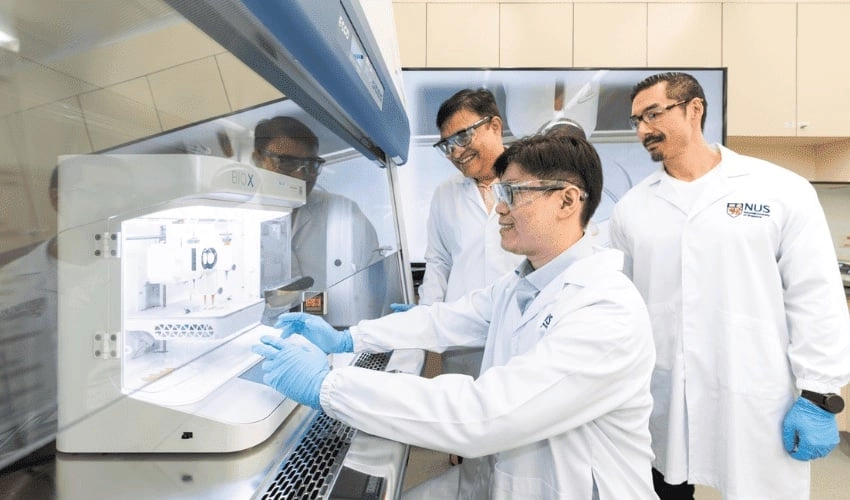
A team from the National University of Singapore (NUS) has developed a new method for creating customized gum grafts using a combination of 3D bioprinting and artificial intelligence (AI). This innovative technique, led by Assistant Professor Gopu Sriram from the Faculty of Dentistry, presents a less invasive alternative to traditional grafting procedures, which often involve painful tissue harvesting from the patient’s mouth and are limited by the available tissue.
The new approach simplifies the treatment of gum-related issues, such as those arising from periodontal disease and dental implants. By creating grafts tailored specifically to each patient, the method promises improved treatment outcomes, enhanced comfort, and a reduced risk of complications, including infections, during recovery.
Traditional gum graft procedures tend to be uncomfortable and can result in complications due to limited tissue availability. To address these issues, the researchers have leveraged 3D bioprinting technology, creating a specialized bioink that fosters cell regeneration while ensuring the printed tissue maintains accurate structure and stability.
Success in 3D bioprinting is contingent on various factors, including extrusion pressure, printing speed, nozzle size, bioink viscosity, and printer temperature. Previously, fine-tuning these parameters was a tedious trial-and-error process. The integration of AI has streamlined this stage, significantly reducing the number of required experiments to optimize printing conditions—from potentially thousands to just 25 combinations.
The resulting gum grafts exhibit remarkable biomimetic properties, demonstrating cell viability exceeding 90% immediately after printing, lasting for 18 days in culture. They have maintained their shape and structure, showing the presence of essential proteins and a multilayered organization that mirrors natural gum tissue.
Professor Dean Ho, head of the biomedical engineering department at NUS, emphasized the impact of AI on expediting the 3D bioprinting process, stating that it addresses a critical bottleneck in the workflow.
This research illustrates the potential convergence of AI and 3D bioprinting to tackle complex medical challenges through precision medicine. By optimizing tissue grafts for individual patients, it aims to minimize the invasiveness of dental procedures while enhancing healing and recovery.
The implications of this technique extend beyond gum grafts, as the ability of oral tissues to heal without scarring could pave the way for developing grafts for other types of tissues, such as skin. This advancement might significantly improve skin wound healing without leaving lasting marks. More information is available in the press release from the National University of Singapore here.