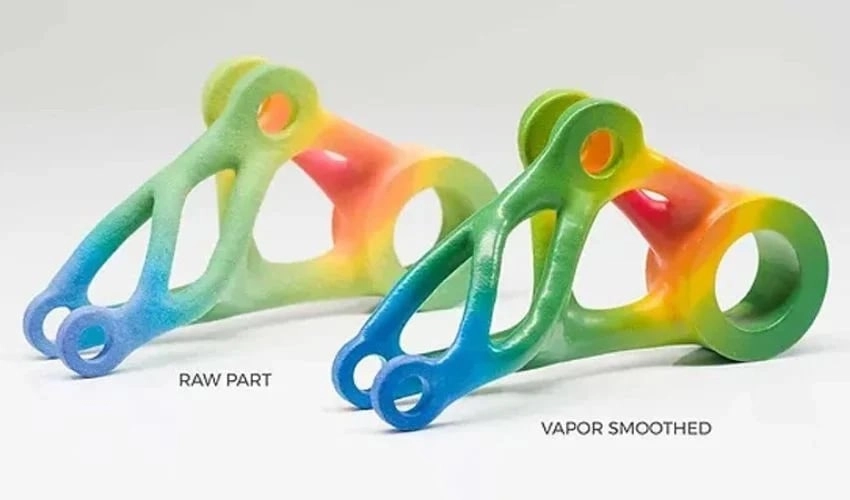
Many 3D printed parts are not immediately ready for use; they often require cleaning and finishing to enhance their mechanical properties and surface finish. Various techniques exist for post-processing, and one such method is vapor smoothing, which is particularly effective for thermoplastics.
Vapor Smoothing Process
Vapor smoothing involves applying steam along with a chemical solvent to the surface of the 3D printed part. This process takes place in a sealed, heated chamber where the steam condenses on the part’s surface, causing the top layer to liquefy. As the surface molecules reorganize, irregularities such as rough areas and pores are smoothed out, resulting in a glossier finish. A specialized smoothing chamber automates several stages of this process, including heating and solvent extraction.
For optimal results, it’s important that parts do not touch each other during treatment. Depending on the geometry of the part, temporary supports may need to be designed and removed post-treatment.
Compatibility with Materials
Vapor smoothing is compatible with various thermoplastic materials, including PA, ABS, PC, PLA, PP, TPU, and PETG. The process is especially popular for SLS and MJF parts, which tend to have rough surfaces, but can also be used for FDM-printed components.
The chemical agents used for vapor smoothing vary depending on the material. For example, acetone is commonly used for ABS, while trahydrofuran (THF) is suitable for PLA.
Advantages
The main benefit of vapor smoothing is its ability to enhance the surface quality and aesthetics of 3D printed components, bringing them close in quality to injection-molded parts. A smoother surface not only improves the appearance but also makes cleaning easier, yielding parts that are more resistant to dirt and bacteria. The process also enhances mechanical properties, such as tensile strength and flexibility, particularly beneficial for thin-walled components.
This sealing effect makes the parts water-repellent and resistant to chemicals, which is essential for applications in mechanical engineering, automotive, and aerospace sectors. In the medical field, the improved hygiene of vapor smoothed parts opens up possibilities for use in devices and utensils that meet stringent health standards.
Limitations
Despite its advantages, vapor smoothing has limitations. Proper positioning of parts in the smoothing chamber is crucial to avoid surface damage. Parts thinner than 1-2 mm may warp during treatment, and care must be taken when handling the chemicals involved, as they carry inherent risks.
Manufacturers of Vapor Smoothing Solutions
Currently, few manufacturers offer dedicated vapor smoothing solutions. Notable companies in this field include AMT, which provides systems like the PostPro SFX; DyeMansion with its Powerfuse S series; and the German start-up ASM, which specializes in rapid post-processing solutions.
In summary, vapor smoothing is a highly efficient and effective method for enhancing the quality of 3D printed parts, making it a favored choice across various industries.