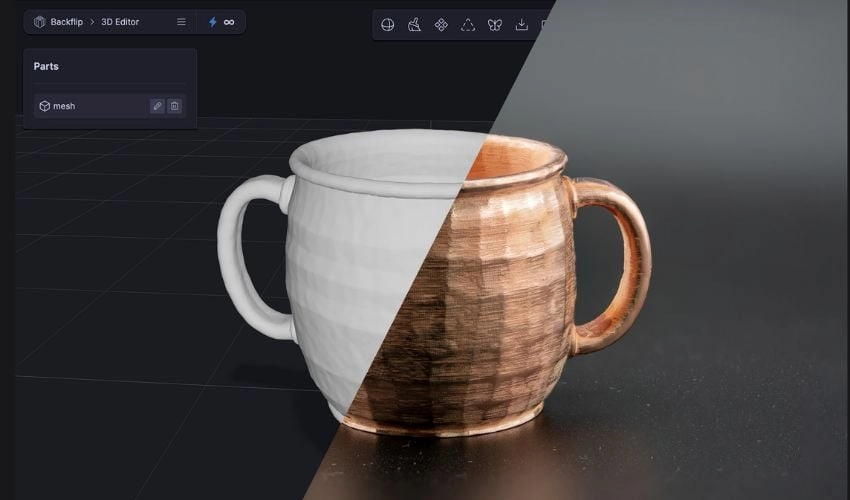
Last December, Markforged co-founders Greg Mark and David Benhaim made waves with the launch of their new startup, Backflip, backed by a $30 million Series A funding round. With their history of success at Markforged, a pioneer in metal and carbon-fiber 3D printing, it’s no surprise that Backflip has attracted significant attention. The company offers an artificial intelligence design tool that generates 3D models, distinguishing itself from existing 3D model generators that often struggle to produce print-ready models without extensive editing.
Backflip aims to enhance the 3D design process by allowing users to transform their ideas—be it a drawing, sketch, photo, or text—into detailed 3D models with one click in about a minute. Greg Mark explained that the company’s foundation comes from recognizing that 3D design is a major barrier for creators looking to make physical products. After stepping away from Markforged to reflect on manufacturing technology advancements, Mark realized Backflip could revolutionize how individuals approach 3D design and creation.
The response to Backflip’s launch has been overwhelmingly positive, leading to unexpected exponential growth in user traffic. Mark expressed gratitude for their investors, particularly NEA and Andreessen Horowitz, who have been pivotal in supporting their vision and contributing to their infrastructure development.
Backflip distinguishes itself from other 3D model generators through its focus on delivering high-quality, usable models geared towards effective 3D printing. Mark emphasized the importance of producing detailed models that not only fulfill aesthetic standards but also meet practical usability requirements. The team has leveraged their industry experience to create a vast synthetic data set that trains their AI model to produce manufacturable 3D models.
The target audience for Backflip spans various creative fields, including established manufacturers, Hollywood prop designers, toy manufacturers, and video game developers. Backflip not only caters to design professionals looking to streamline their creative processes but also welcomes novices who may lack experience with traditional design tools.
While addressing potential environmental concerns associated with AI, Mark asserted that Backflip has adopted a more efficient approach compared to conventional large language models (LLMs), leading to a significantly reduced environmental footprint.
Looking forward, Backflip is committed to advancing its platform, incorporating user feedback to introduce new features and functionalities throughout the year. Those interested in contributing to Backflip’s mission are encouraged to explore employment opportunities available on their website.
For more about Backflip, visit their website.