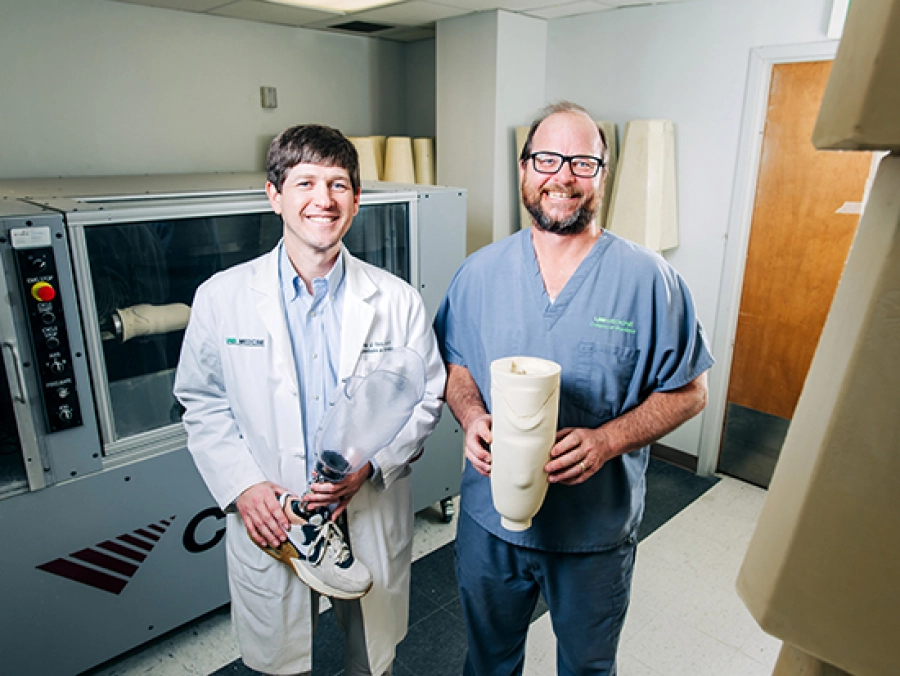
Each year, hundreds of patients visit the Amputee Clinic at the UAB Spain Rehabilitation Center to be fitted for prostheses following various conditions such as diabetes and motor vehicle accidents. A new grant from UAB’s Health Services Foundation-General Endowment Fund is facilitating the purchase of an advanced 3D printer, which is expected to significantly improve the prosthetic fitting process. According to Conley Carr, M.D., the clinic’s director, this technology will allow patients to receive their prostheses faster, at a lower cost, and with better customization.
This upcoming installation will make UAB’s Amputee Clinic the first in Alabama and one of the few across the nation to offer 3D-printed sockets for prosthetics. Carr, also an assistant professor in the Department of Physical Medicine and Rehabilitation, emphasizes that while the practice of 3D printing prosthetics is still rare, the imminent benefits will likely catalyze its adoption at larger medical centers.
The demand for prosthetics in the U.S. is projected to increase dramatically, with a study indicating that by 2050, the number of people living with limb loss will double, primarily due to rising rates of vascular disease and diabetes. This trend is evident within the Amputee Clinic, where approximately 70% of patients have lost limbs due to these health issues. Carr mentions that as the population ages, their clinic’s demand is also on the rise, leading to significant expansions in staffing and services.
Once the 3D printer is operational, it’s expected to reduce the time taken to create prostheses by nearly 60%. With 3D scanning and printing technology, practitioners can craft devices that conform precisely to individual patients’ anatomy, thereby minimizing complications like poor fit or skin breakdown. The technology enables the addition of personalized features, enhancing mobility, safety, and comfort.
Traditionally, creating a prosthesis involves making a plaster mold of the limb, which is an extensive and labor-intensive process. The 3D scanning technology already in use at UAB has streamlined some of this work, allowing for the transformation of digital files into foam shapes for initial testing. With the new printer, Carr and his team can produce finished prostheses directly from digital scans.
Moreover, the 3D printer will also be utilized for creating custom orthoses for patients needing supportive braces post-stroke or due to other conditions. The introduction of this technology promises to significantly reduce wait times for patients in need of these devices.
However, expanding this cutting-edge service does have its challenges, particularly concerning the physical space required for the new printer and related equipment. Carr and his team are hoping to extend their facilities as they prepare the transition of services to the recently developed UAB Rehabilitation Pavilion, which is expected to open soon.
For more information, visit the UAB Spain Rehabilitation Center and learn more about the Health Services Foundation.