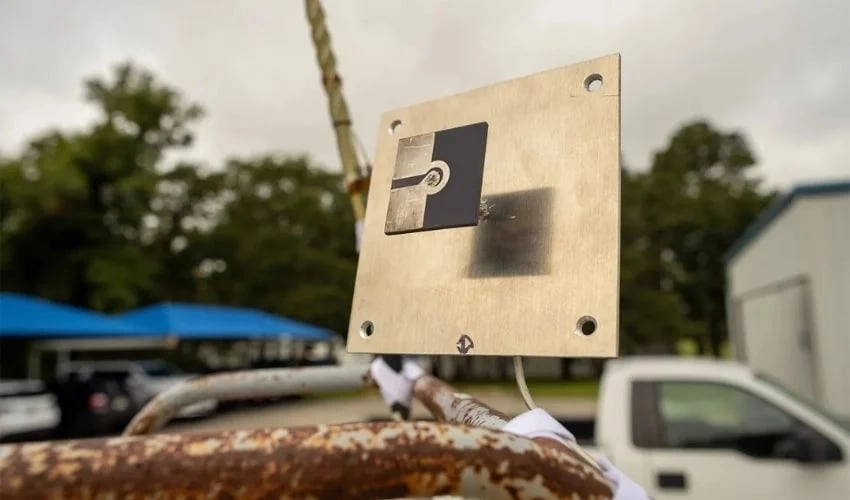
Aerospace is a field where additive manufacturing is proving transformative, particularly in telecommunications. NASA has recently made strides in this area by developing more accessible antennas through 3D printing technology. Antennas play a critical role in enabling communication during space missions, facilitating data transmission between satellites, probes, and Earth.
Engineers from NASA’s Near Space Network, together with the Electronics 3D Printing team at Goddard Space Flight Center, successfully created and tested a 3D printed antenna using Fortify’s innovative technology. The project’s goal was to showcase cost-effective design and manufacturing capabilities tailored for efficient antennas that meet current industry specifications. This antenna was tested with relay satellites and launched via a weather balloon from NASA’s Columbia Scientific Facility in Palestine, Texas. Remarkably, the entire development process took just three months, marking a significant achievement in manufacturing low-cost communication devices for forthcoming space operations.
The creation of 3D printed antennas faces various challenges, especially those arising from the integration of materials with distinct electromagnetic properties needed for effective signal transmission. Engineers crafted an optimized structure and utilized cutting-edge materials, including a “low electrical resistance, tunable, ceramic-filled polymer material.” This material enhanced the antenna’s signal tuning. Once the design was finalized and the printing completed, the antenna underwent tests with NASA’s relay satellites before being elevated to high altitudes on a weather balloon.
The antenna was produced using Fortify’s technology, a startup specializing in manufacturing radio frequency devices. While the specific printer model remains undisclosed, Fortify provided a Flux One printer to NASA’s Glenn Research Center in August of the previous year. This platform enabled engineers to control the electromagnetic and mechanical qualities of the antenna efficiently, allowing fabrication within a matter of hours. The final product was a magneto-electric dipole antenna, celebrated for its doughnut-shaped radiation pattern, which is commonly utilized in telecommunications.
For initial testing, the antenna was subjected to evaluation in the electromagnetic anechoic chamber at NASA’s Goddard Center in Greenbelt, Maryland. The chamber minimized electromagnetic interference, facilitating an accurate performance assessment. Later, field tests occurred at the Columbia Scientific Balloon Facility in Texas, where the 3D printed antenna was compared against a standard satellite antenna, evaluating its effectiveness from various angles and altitudes.
The antenna faced rigorous testing by being installed on a weather balloon, which was propelled to an impressive height of 100,000 feet (over 30 kilometers), to assess its data transmission capabilities. The results were promising, as the antenna successfully transmitted and received data, confirming its potential for future space applications.
This pioneering project by NASA not only paves the way for the development of more efficient communication systems tailored to specific missions but also highlights the advantages of rapid prototyping, along with the design and material flexibility afforded by additive manufacturing.