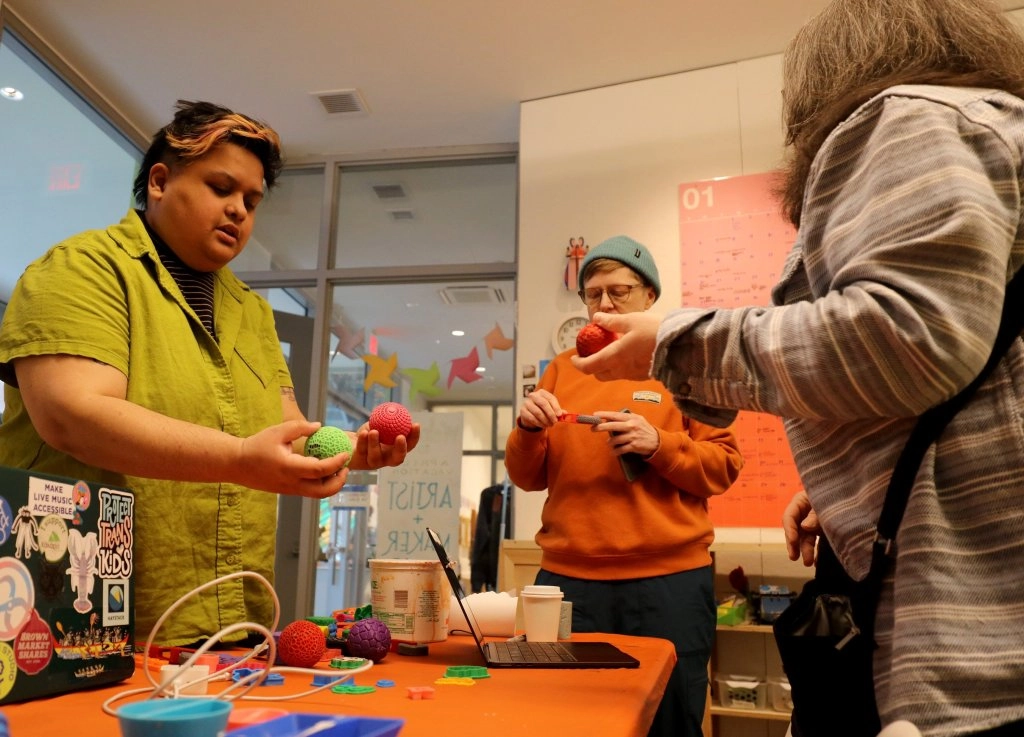
A small group of art students in Waterville recently participated in a class focused on merging traditional art with cutting-edge technology through 3D printing. The workshop, titled “3D Printing: For Ceramic Arts,” was held at the Paul J. Schupf Art Center and was led by local artist Misha Oraa Ali.
During the three-hour session, students learned to design their own molds and tools from the ground up. They started by sketching simple designs on paper, which then transformed into 3D printed tools usable in their ceramic projects or even for baking. This was the first class of its kind at the center, aimed at introducing artists to the innovative world of 3D printing.
Lisa Wheeler, the education manager at Waterville Creates, commented on the enthusiasm of participants to learn about this new technology. “What’s great is that a lot of people are really open to learning the technology of 3D printing if they didn’t already know about it,” she noted. This course presents the opportunity for students to create customized tools tailored to their artistic needs, rather than relying solely on pre-designed models.
The class featured a vibrant display of 3D printed shapes that students could explore and draw inspiration from, including a layered pyramid and a cat-shaped cookie cutter. One attendee, Robyn Head, who has a background in design, expressed her interest in creating custom art tools. She stated, “Thinking about it more in terms of making your own custom tools… that appeals to me.”
Oraa Ali’s passion for both art and science influenced the creation of this course. Her academic background in cognitive science and experience in a makerspace in Rhode Island drove her to combine these fields. “I was in grad school for cognitive science, but I always felt like I didn’t want to silo myself in science,” she explained, emphasizing her desire to incorporate creative expression into her work.
The introduction of this class was made possible by grants, including one from the Davis Family Foundation, which provided new laptops and iPads, and another from the Perloff Family Foundation that funded state-of-the-art 3D printers.
Students expressed excitement about the hands-on experience and the potential of using the new 3D printers. Nicole Solis Clewley, a senior participating in the workshop, noted this was an excellent opportunity for her as it combined her artistic interests with practical applications in baking.
As they continue their learning, students have the opportunity to attend follow-up classes to enhance their skills, focusing on adding textures and further exploring the capabilities of the 3D printers. Wheeler highlighted the significance of merging traditional ceramic arts with modern technology, stating, “I’m excited that this is the first one, and we’ll see where it goes in our space.”