A groundbreaking 3D printer, capable of creating houses and seawalls, made its way to Florida at the end of last month. This innovative technology holds the promise of addressing hurricane-related challenges while also enhancing the local workforce and construction sector.
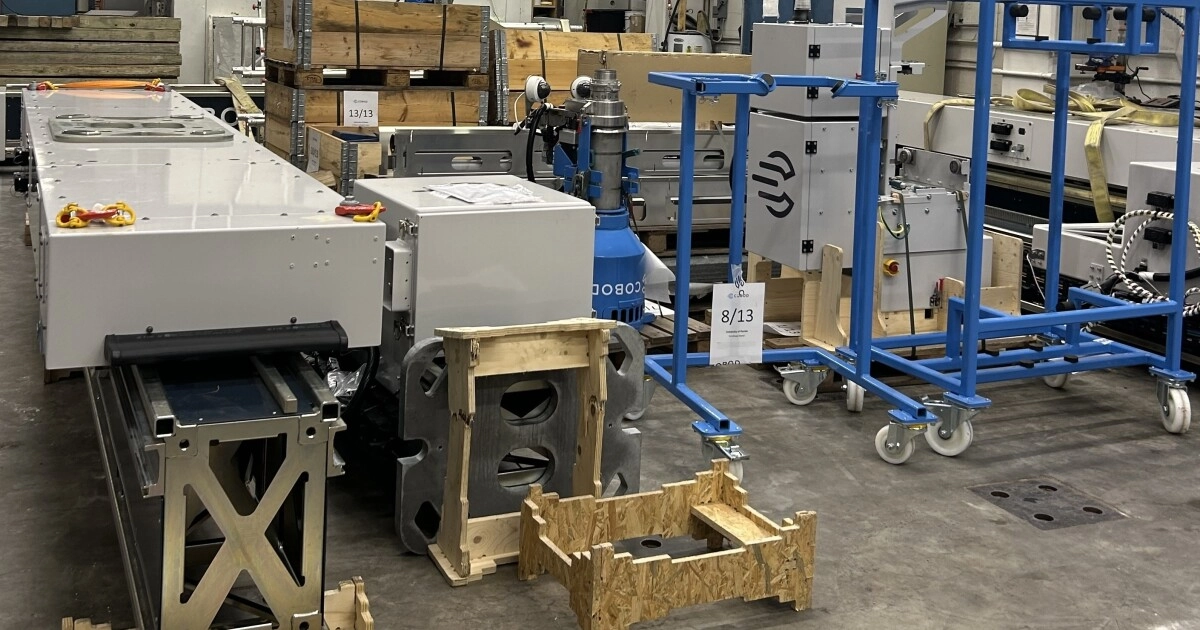
The two-story construction printer, referred to as BOD3, is produced by the Denmark-based company COBOD International and was sent to the University of Florida’s East Campus last month.
Upon its arrival on September 20, it marked a significant milestone as the first BOD3 to reach the United States and one of the earliest models to be circulated following the launch of this new version in September.
According to Chaofeng Wang, an assistant professor at UF’s M.E. Rinker, Sr. School of Construction Management, the BOD3 is described as a robotic system intended for infrastructure construction. This means that once the coding is completed and the necessary materials are available, the printer is capable of executing projects autonomously.
The innovative material is a unique concrete formulation created directly at the site, according to Wang. He noted that utilizing this concrete in construction can lessen the effects of hurricanes, as it offers significantly greater structural strength compared to other building materials.
“There is considerable damage to wooden homes. Just think about the possibility of printing those homes using concrete,” Wang remarked. “You wouldn’t have to worry about storm winds or flooding anymore. We have the potential to construct a new era of resilient and sustainable infrastructure.”
Wang expressed that Florida is an ideal location for BOD3.
“I’m truly enthusiastic. I believe Florida is a prime area for this type of research because we can quickly implement the findings into real-world scenarios, particularly with regard to hurricanes,” he added.
Iris Rivero, who chairs the Industrial and Systems Engineering department at the University of Florida, played a pivotal role in introducing BOD3 to the state. She mentioned that the state significantly influenced the decision to invest approximately $800,000 in the printer.
“Given the numerous hurricanes and other events we’ve been experiencing, Florida finds itself in a situation where we can consider more resilient strategies for community building,” Rivero noted. “There are increased opportunities that may align with the state’s requirements and priorities.”
In contrast to its predecessor, BOD2, BOD3 boasts enhanced mobility. Its modular design allows it to expand and contract as necessary, making it suitable for various printing tasks.
Rivero explained that part of the University of Florida’s research involving the printer will examine how its mobility enables it to remain ready for action when severe weather approaches.
“Is it possible to create procedures that allow immediate preparation for formations in the sea, enabling us to construct shelters promptly?” she asked. “In the face of tornadoes, floods, and hurricanes, can we effectively deploy a system to start building right away? That’s a key area of interest for us.”
According to COBOD’s website, the modular and mobile design of BOD3 enhances the efficiency of the printer. Projects can be completed in less time, and its expandable track-based system facilitates continuous printing, making it particularly beneficial for construction sites with multiple housing developments.
This innovation means that communities impacted by hurricanes could potentially rebuild quicker and recover faster.
Beyond mitigating the effects of adverse weather, Rivero emphasized that BOD3 will assist individuals in their development and address the needs of both communities and industries.
“We are initiating programs focused on workforce development, which will be critically important,” she mentioned. “We have experienced a significant loss of personnel in the construction sector…so what are the innovative methods? How can we effectively implement these techniques and enhance individuals’ résumés in this field?”
Rivero emphasized that another key factor is sustainability and addressing the challenges related to supply and demand fluctuations.
By sourcing concrete materials locally, businesses can establish a presence within their communities and minimize the carbon footprint caused by transporting raw materials.
She mentioned that ultimately, she aspires for enough individuals to be proficient in using the printer so that it can be rapidly deployed during emergencies or utilized for various purposes—whether industrial or creative.
Rivero mentioned that the training on the machine is open to everyone interested.
He explained that the printer is situated at the Weil Hall Structures and Materials Laboratory intentionally, as it offers convenient access for users.
BOD3 is in the process of being assembled in the lab, where associate engineer Taylor Rawlinson emphasized that fine-tuning the printer’s concrete material is the main priority.
Rawlinson stated that BOD3 has the capability to process between 4 to 6 cubic yards of concrete each hour.
“It’s quite the undertaking,” he remarked. “We have a substantial amount of material that we plan to utilize.”
He emphasized that perfecting that material on a smaller scale is crucial prior to advancing to larger constructions.
Currently, BOD3 will be fabricating small objects—such as walls, dog shelters, and igloos—in the laboratory before applying them in practical settings. Rawlinson mentioned that the ultimate aim is to eventually construct a showcase research facility on UF’s eastern campus.
Investigations conducted at UF and in real-world environments will assist COBOD in refining its innovative designs and determining subsequent actions.
Zoë Knudsen, who leads products and communication at COBOD, emphasized the importance of user feedback, stating it is “huge.”
“Any feedback we receive or key insights from their experiences with our machines play a pivotal role. We use this information to guide our team in creating even more advanced and capable products and machines,” she explained. “Our goal is to push [3D construction printing] even further.”
According to Knudsen, construction initiatives utilizing the BOD3 are just starting to emerge.
“Currently, three printers are operational in Indonesia and Angola, which is quite fascinating to observe,” she noted. “Additionally, the University of Florida is set to participate in this new printer model, which is incredibly exciting.”
The assembly of BOD3 is anticipated to take place in December or January, coinciding with a two-week in-person training session conducted by its manufacturer.