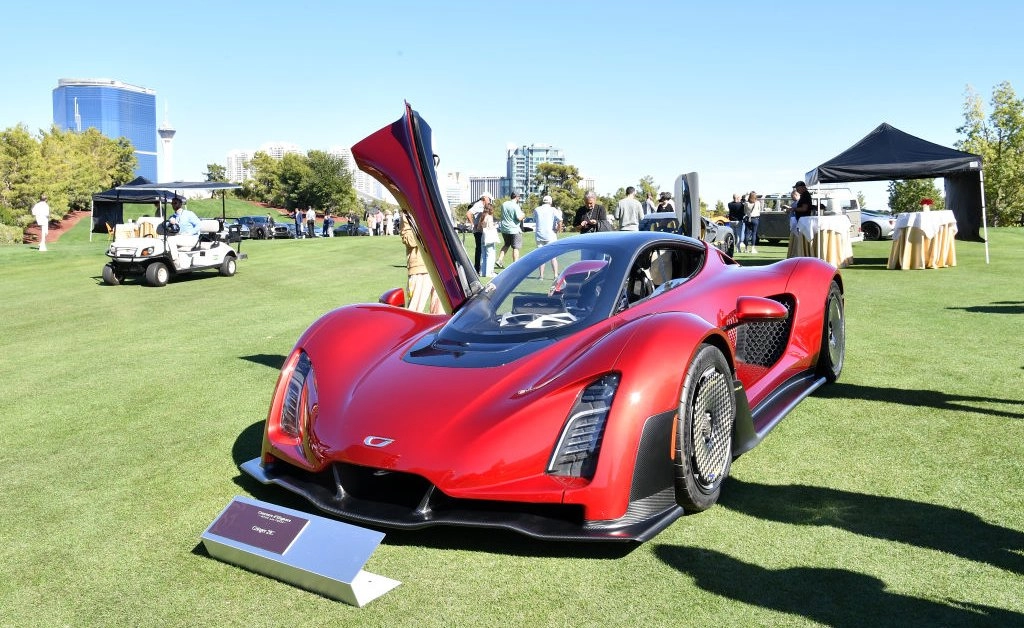
A groundbreaking newcomer in the automotive industry, renowned for its 3D-printed hypercar, has been breaking speed records throughout this summer. The 21C, crafted by Czinger from Los Angeles, set the Laguna Seca track record for production cars in California on August 26. This follows its achievements of setting a new record at the F1 circuit in Austin and breaking the hillclimb record for production cars at the Goodwood Festival of Speed, a well-known motorsport event in the UK, all within a month.
“This summer has been record-setting for us,” commented Lukas Czinger, the co-founder, COO, and president of Czinger. “It’s been quite exciting.”
But the visions of Lukas and his father, Kevin Czinger, the CEO of the company, extend beyond merely setting speed records. The 21C serves as a prime example of what can be achieved through their parent company Divergent’s comprehensive design and manufacturing system, which incorporates artificial intelligence, advanced materials science, and 3D printing. By using this technology, the company aims to optimize the design process to minimize material use.
The approach is already showing fruitful outcomes. This summer, Divergent, managed by the father-son team as well, began working with luxury automotive brands like McLaren and Bugatti to design and produce components. The company aims for its cutting-edge manufacturing platform to eventually extend beyond luxury cars to the wider automotive market and even to aerospace and other sectors. “If we execute our plans properly,” Lukas Czinger stated, “this could become the largest manufacturing system globally within a decade.”
Launching an innovative American automaker often begins with a high-tech sports car, as was the case with Tesla’s introduction of the Roadster in 2008. This strategy, part of Elon Musk’s “master plan,” was to utilize the revenue from luxury vehicles to create more accessible models. Similarly, Divergent is making its mark, but with a distinct goal. Instead of producing its own mass-market vehicles, Divergent aims to offer its comprehensive system to assist other producers in designing and manufacturing cars sustainably.
The Divergent Adaptive Production System (DAPS), a combination of software and hardware, was utilized in creating the Czinger 21C. This system enables the construction of vehicles that are not only lighter but more aerodynamic. Such advancements are more than just beneficial for setting speed records; they could also enable major automakers to reduce costs while enhancing sustainability. Lukas Czinger points out, “If you save 20 to 30% of a vehicle’s chassis mass, and apply that reduction across hundreds of millions of cars, the impact is enormous.”
Read more: NASCAR Debuts EV Prototype
This approach to production has many benefits at various stages. The company employs AI models to tweak human designs for optimal savings. As Lukas Czinger explains, this was crucial in making the 21C’s chassis and suspension as efficient as possible, removing any excess material without compromising vehicle performance. Additionally, DAPS incorporates 3D printing which strategically layers materials, reducing waste significantly. This is a stark contrast to traditional methods like machining, where excess materials need to be either recycled or disposed of, highlighting how DAPS’s technology fosters significant material and cost savings.
DAPS has another trick up its sleeve. A typical car factory makes only a handful of models because the equipment, such as the molds used to make the chassis, are specific to only those vehicles. By contrast, the 3D printing process used in the Czinger 21C’s production is “product independent,” meaning a single factory could be used to make “200, 300, a thousand” different products, Lukas Czinger says.
That will make it easier for newer players to work with Divergent to produce limited runs of new designs for niche markets without investing in a factory. As the technology becomes more affordable, Divergent aims to replace large-scale in-house manufacturing with a new model where companies focus on design and outsource production to its adaptable factories. “Just like with the cloud,” says Lukas Czinger, referring to how businesses now rely on Amazon or Microsoft for computing rather than maintaining their own servers, “you’ll see dozens of Divergent facilities worldwide producing for all industries.”
Though, for now, its technology is the exclusive realm of those willing to pay “bomb prices.” Czinger expects to finish its limited run of 80 21Cs in the first half of 2026. Each one starts at $2 million.
As the “summer of records” wraps up, the company faces its next challenge: translating success on the track into market traction. But Kevin and Lukas believe their relationship gives them an edge. “There’s a level of politics when you’re building a large business,” Lukas says. “We don’t have any of that.”