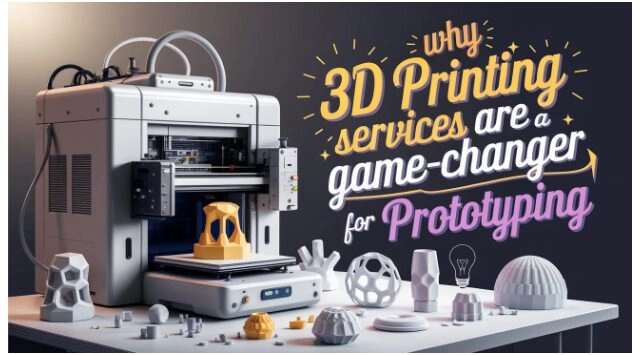
Do you remember the days when prototyping was an expensive, slow, and often frustrating process? Traditional methods demanded a significant amount of time, effort, and above all, patience. Thankfully, those days are long behind us. Now, 3D printing services offer a quicker, more affordable, and more precise alternative for developing prototypes.
In this blog post, we’ll explore the advantages of 3D printing services for rapid prototyping and discuss their potential to transform the realms of product design, inventors, and businesses planning new product development.
Firstly, let’s clarify what 3D printing services entail. 3D printing is a process that produces solid physical objects from digital models by sequentially adding material layers, such as plastic, metal, or ceramic, which are then fused together to form the object. This results in highly accurate prototypes that are useful for testing and enhancements, rendering them extremely reliable.
In the past, prototyping was a daunting and exhausting task, as it involved producing multiple physical iterations of a design. Such processes were not only time-intensive and costly but also demanded substantial resources, making it challenging for many companies to pursue. However, with the advent of 3D printing services, rapid prototyping has become not just a possibility, but a practical and accessible reality. This technology enables companies to quickly design, create models, and refine them in a short timeframe before moving to production stages.
The beauty of 3D printing lies in its ability to rapidly transform ideas into tangible models. Unlike traditional manufacturing that often necessitates numerous tools and elaborate setups, 3D printing allows for the immediate creation of parts as soon as their designs are finalized. This accelerated pace of product development is indeed groundbreaking.
Here’s how it works:
Once a designer finalizes a 3D model or a CAD file, they can proceed directly to the 3D printer to bring their design to life. This eliminates the lengthy delays associated with conventional manufacturing techniques.
After printing and necessary post-processing, the part is ready for immediate testing. Designers have the flexibility to revise the model and reprint if needed, based on the feedback received from testing in real-world conditions.
Similarly, the integration of unique requirements into a design or meeting specific client needs can be efficiently achieved without overhauling the entire manufacturing process.
This method enhances the speed of product development and facilitates the swift realization of new ideas and innovations.
Rapid prototyping is a technique used in the fabrication of prototypes using various manufacturing processes, including 3D printing. Here’s an overview of how 3D printing facilitates rapid prototyping:
The initial step in the design process involves creating a 3D model using CAD software.
The CAD model is converted into an STL format, which is readable by the printer.
This printer constructs the prototype layer by layer, utilizing materials such as thermoplastics and metal powders.
Sometimes, sanding or polishing is required to finalize the prototype according to the model’s design specifications.
The final stage involves testing the prototype to assess its functionality and gather feedback.
The ability of 3D printing for rapid prototyping to produce detailed designs and impeccable surface finishes stands out as one of its highlights. This technology can replicate prototypes resembling those from traditional injection molding processes.
Navigating through a myriad of 3D printing service providers can present a challenge. When selecting a service, consider these critical aspects:
Search for service providers that utilize high-quality machines and have a track record of producing precise prototypes, such as 3DJobber.
Prioritize companies known for their fast delivery and flexibility in production scheduling.
Compare the costs and services provided by various suppliers to get the best value for your budget.
To summarize, 3D printing services have become a vital tool for organizations seeking to innovate and stay ahead of the competition. They have changed the way we design, develop, and manufacture items by providing speed, flexibility, cost-effectiveness, and the ability to iterate. As technology advances, we expect to see even more fascinating discoveries in the field of 3D printing.
Read More From Techbullion