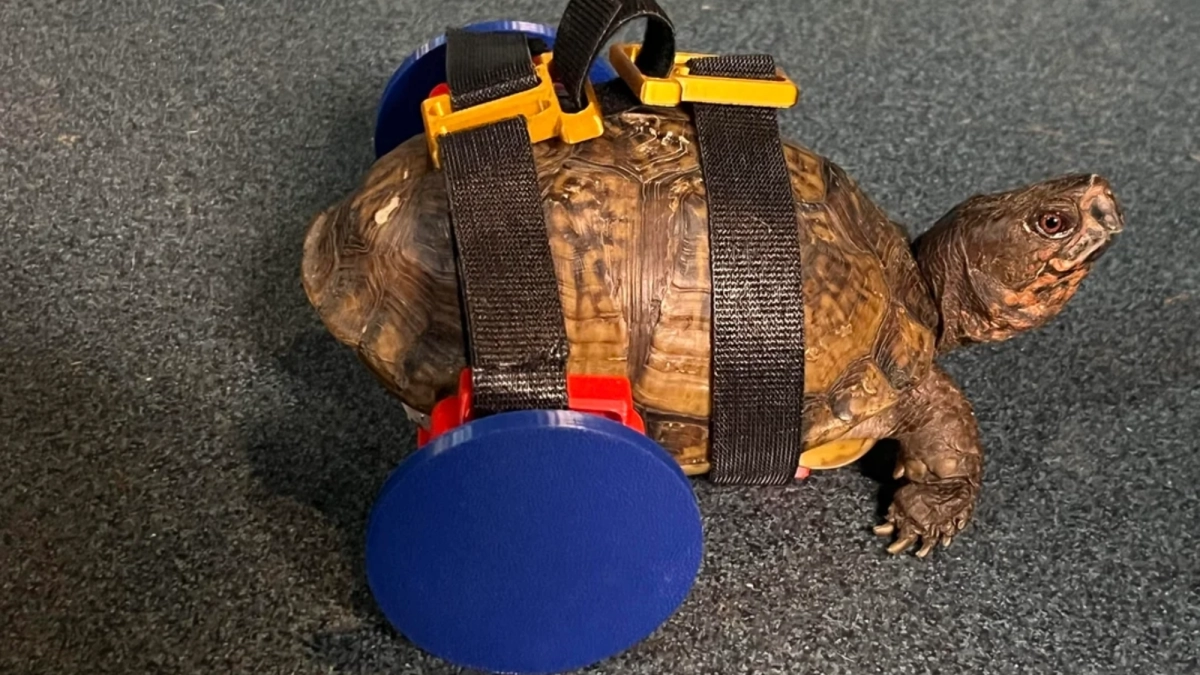
A Gulf Coast box turtle named Moses, who has lost both of his back legs, is regaining his ability to move thanks to a 3D-printed wheelchair created by an aquarist known online as jawscritters. After receiving input from the 3D printing community on Reddit, jawscritters refined the design to better suit Moses’ needs. The modified wheelchair allows Moses to navigate more effectively, and the 3D files for the design are now available online for others to use in similar situations.
Initially, jawscritters was approached by a coworker from the Mississippi Aquarium to help Moses, who struggled to move without his back legs. Within 24 hours, he devised a plan to create a custom wheelchair. The first prototype featured wheels resembling those of a toy truck secured to the turtle’s shell with a harness. Subsequent designs improved on the initial concept, making the wheels thinner and the axles shorter to facilitate tighter turns.
Some modifications did not work as planned, such as a front bumper that made it harder for Moses to maneuver. Despite these challenges, jawscritters expressed satisfaction with Moses’s newfound mobility and is hopeful that the shared design will assist other turtles in need.
This isn’t the first instance of turtle wheels. In 2018, veterinarians at the Maryland Zoo created a LEGO wheelchair for an injured Eastern box turtle that helped it heal by lifting its shell off the ground while allowing movement. Similarly, in 2019, veterinarians at LSU designed a removable axle and wheels for a pet turtle named Pedro, who had also lost his back legs.
The advancements in 3D printing technology are pivotal in creating custom mobility aids for animals. In a recent project, volunteers helped create a harness for a sea turtle suffering from a condition known as bubble butt syndrome, demonstrating the versatility of this innovation in animal care.
The collaboration between enthusiastic caretakers and the accessibility of 3D printing highlights a promising future for custom solutions in wildlife rehabilitation, ensuring that more animals like Moses can enjoy significant improvements in their quality of life.