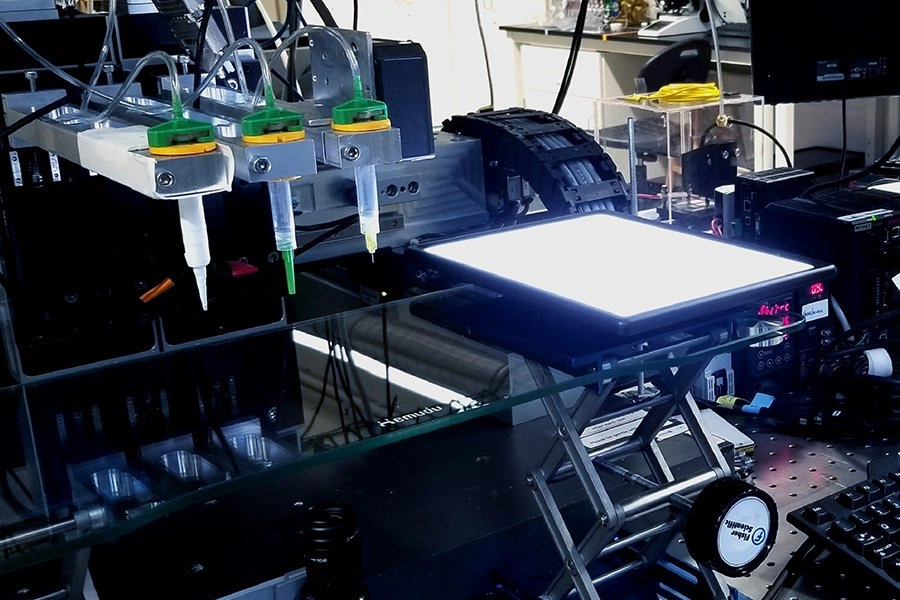
On August 24, 2024, the University of Minnesota Twin Cities unveiled a breakthrough in adaptive 3D printing technology, designed to autonomously identify and manipulate randomly distributed living organisms. This technology is set to enhance the efficiency of various applications such as cryopreservation, cybernetics, bioimaging, and the creation of devices integrating biological components, by reducing time and resource consumption.
The revolutionary adaptive 3D printing system excels in the precise management of living organisms. Capable of autonomously tracking, acquiring, and deploying organisms accurately—whether they are static or mobile—the system leverages real-time visual and spatial data to precisely place organisms, which is critical for applications that involve embedding them into materials or devices. The significance of this technology is underscored through its publication in the peer-reviewed journal Advanced Science, and the filing of a patent, illustrating its groundbreaking nature and anticipated influence on numerous sectors.
Guebum Han, who led the research and previously worked as a postdoctoral researcher in mechanical engineering at the University of Minnesota, described how the system functions: “The printer operates similarly to a human, with the printing mechanism serving as hands, the vision system as eyes, and the computer as the brain. This allows the printer to adapt in real-time to both stationary and moving organisms, organizing them into specific arrays or patterns.”
Historically, tasks like these have required manual execution, extensive training, and often led to inconsistent outcomes. The newly introduced system not only reduces the time needed to perform these tasks but also increases the consistency of results. This is especially significant in areas such as cryopreservation, where precise handling of organisms is essential. The system is capable of distinguishing between live and deceased organisms, positioning organisms on curved surfaces, and amalgamating them with various materials and devices into customized configurations. It also offers the possibility to create intricate structures, such as superorganism hierarchies, observed in insect communities like those of ants and bees.
This advanced technology could transform various biological and engineering sectors by enhancing cryopreservation efficiency, enabling the segregation of live from deceased organisms, and allowing for the placement of organisms on diverse surfaces, including curved ones. Furthermore, it opens opportunities for constructing detailed organism configurations analogous to superorganism hierarchies prevalent in insect colonies.
For example, the technology was shown to accelerate the cryopreservation of zebrafish embryos by 12 times compared to conventional manual techniques. The adaptive features of the system were also highlighted during tests where it effectively identified, picked, and positioned actively moving beetles, incorporating them with operational devices.
Looking forward, the research team plans to integrate this technology with robotic systems, potentially enhancing its portability for field use. This advancement could enable researchers to gather and process organisms in locations that are otherwise challenging to reach. Additionally, this technology could significantly advance autonomous biomanufacturing by facilitating the evaluation and integration of live organisms in novel and innovative manners.
This ground-breaking initiative was a joint undertaking by numerous individuals from the University of Minnesota’s Department of Mechanical Engineering. It featured the collective efforts of graduate research assistants Kieran Smith and Daniel Wai Hou Ng, Assistant Professor JiYong Lee, Professor John Bischof, Professor Michael McAlpine, and previous postdoctoral researchers Kanav Khosla and Xia Ouyang. The Engineering Research Center (ERC) for Advanced Technologies for the Preservation of Biological Systems (ATP-Bio) also contributed to the project. The research funding was generously provided by the National Science Foundation, the National Institutes of Health, and Regenerative Medicine Minnesota.
The innovative 3D printing system created at the University of Minnesota marks a notable breakthrough in the manipulation and assembly of living organisms. Through automating processes and improving precision, this technology stands to make significant impacts across various fields such as cryopreservation and autonomous biomanufacturing. It’s envisioned that continuous refinement and integration with robotics will broaden potential uses, offering a crucial resource for scientists across different research areas.
Source: cse.umn.edu
Explore how Ford employed Formlabs SLA and SLS 3D printers to prototype, validate, and manufacture intricate components for the new Explorer, their pioneering electric vehicle targeting the European market.
MX3D has announced its participation in the additive manufacturing of “Later Love”, a sculpture by the notable Irish artist Rowan Gillespie. The sculpture will… read more »
The School of Aeronautics, Astronautics and Mechanics at Tongji University, in cooperation with the Shanghai Aircraft Design and Research Institute of COMAC, has… read more »
CollPlant Biotechnologies and Stratasys Ltd. have started a pre-clinical study to further the development of 200cc regenerative breast implants. These implants are produced… read more »
Innovative Space Carrier Inc (ISC), located in Japan, has established a strategic collaboration with WAAM3D, Cranfield University, and Aichi Sangyo to propel the… read more »
Imagine a world where virtual experiences transcend mere visuals and extend to tactile sensations. This phenomenon is progressively being realized as 3D printing merges… read more »
Lamborghini continues to redefine the frontiers of automotive technology with their latest launch, the Temerario, a super sports car that epitomizes peak innovation. Revealed at… read more »
This manual provides you with the necessary steps to design and craft a custom stand and air amplifier. This setup allows you to harness the capabilities similar to those of a Noctua desk fan, but at a significantly reduced cost.
The utility of 3D printing in contemporary engineering cannot be overstated. It plays a critical role in the creation of prototypes, parts, and entire functional products. This cutting-edge technology… read more »
Researchers from RMIT University in Australia, in collaboration with Tescan Group in Czechia and the University of North Texas in the USA, have… read more »