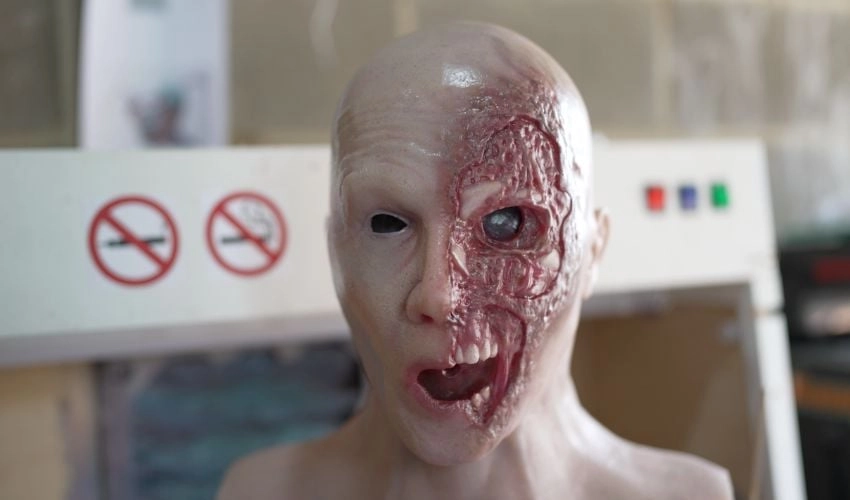
AnthroTek, a pioneering company in the realm of 3D printing, is pushing the boundaries of what additive manufacturing can achieve in mimicking human tissue. The technology has advanced to the point where body parts, skin models, and organs can be reproduced with remarkable fidelity. Specializing in material sciences, AnthroTek produces components for medical simulation, soft robotics, and the film industry, offering a diverse range of 3D-printed applications, from anatomical models to organs that simulate blood flow.
Dr. Raoul Peltier, a co-founder of AnthroTek, shared his journey into 3D printing. With a PhD in material sciences and a creative background in clay sculpting and mask-making, he ventured into 3D modeling and obtained his first 3D printer, significantly enhancing his mask-making process. This led him to create The Face Forge, a brand producing high-end masks that garnered interest from various artists and film productions.
In 2023, after meeting Nazmus Tareque, who recognized the potential in combining Peltier’s expertise in materials science with artistic innovation, AnthroTek was born. Established in 2024, the company aims to address complex issues in medical simulation and soft robotics through advanced material applications. Heavy specializing in soft materials such as silicone and rubber, AnthroTek produces incredibly realistic human tissue replicas.
The company’s production largely hinges on 3D printing technology. They create molded components for artificial organs and custom machine parts using both resin and filament printers. Their most significant challenges lie in printing flexible silicone organs due to their intricate design and soft material properties. Collaborating with Lynxter, who provides specialized equipment for soft materials, has been crucial for their successes in this area.
What sets AnthroTek apart from other 3D printing solutions in the medical field is its strong focus on material science. This allows them to devise unique materials that enhance the function of their prototypes, leading to innovative products like multi-layered skin models that accurately replicate various dermal characteristics and organs that can realistically simulate blood dynamics.
In conclusion, Raoul Peltier encourages others to explore their passions and be open to the possibilities that new technologies present. His journey illustrates how combining scientific knowledge with creative endeavors can lead to inspiring and impactful innovations. For more information, visit AnthroTek’s website.