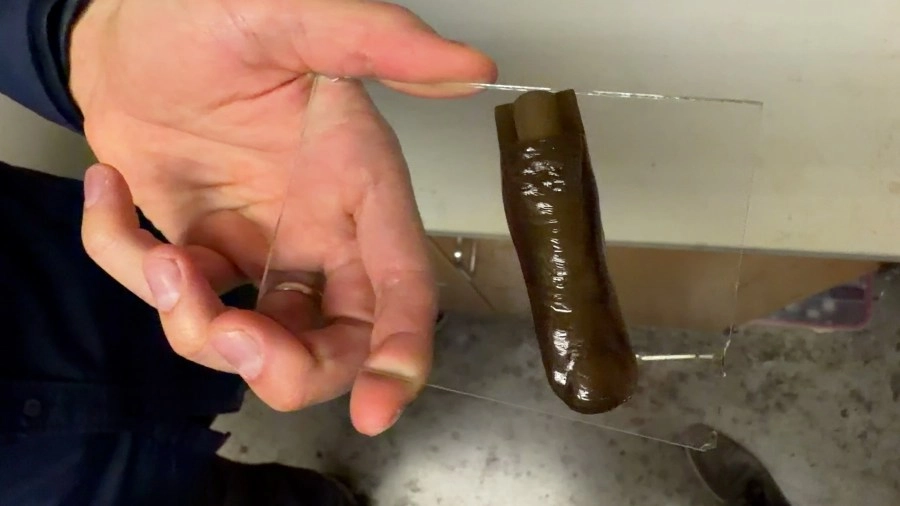
Inside a quiet lab at the University of Texas at Austin, researchers are achieving remarkable advancements in 3D printing technology. They’re not just creating objects; they’re crafting lifelike body parts that have the potential to revolutionize medical training.
A PhD candidate, Elizabeth Recker, demonstrated the vivid capabilities of their new technique, which produces a 3D-printed hand that appears almost human-like. Utilizing digital light processing, the team can print with precision, creating layers thinner than a sheet of paper until a solid object forms. In just 25 minutes, they can produce a fully functional finger that varies in texture, featuring softer parts alongside a rigid center, imitating real anatomical structures.
This innovation arose from what was described as a "serendipitous discovery" by the researchers, particularly through a method they refer to as CRAFT, or Crystallinity Regulation in Additive Fabrication of Thermoplastics. By manipulating light intensity, they can alter the material properties, determining whether it ends up soft, hard, clear, or opaque.
The analogy of butter and oil illustrates this point: tightly packed butter remains solid, while less organized oil stays liquid. By careful control of the resin properties, plastic’s behavior can be fine-tuned during printing, allowing the creation of materials that behave in complex ways like biological tissues, without the need for weak seams often found in multi-material constructions.
The implications of this technology are vast. Page, a chemistry professor leading this effort, envisions applications that extend beyond medical models. Potential uses include impact-resistant materials for helmets and protective equipment, tapping into nature’s optimization strategies.
While the current focus has been on smaller anatomical models, the scalability of this technique allows for larger constructs, potentially leading to full-body training models for medical students. This innovation promises to facilitate training on realistic materials, alleviating the chronic challenge of securing human cadavers for medical education.
In summary, the UT Austin research team is not only advancing 3D printing techniques but is also setting the stage for breakthroughs that could reshape the future of medical training and materials science. Their work stands at the intersection of technology and biology, providing a glimpse into a more sustainable and effective approach to mimicking natural structures.
For more details, you can explore the research published in the journal Science.