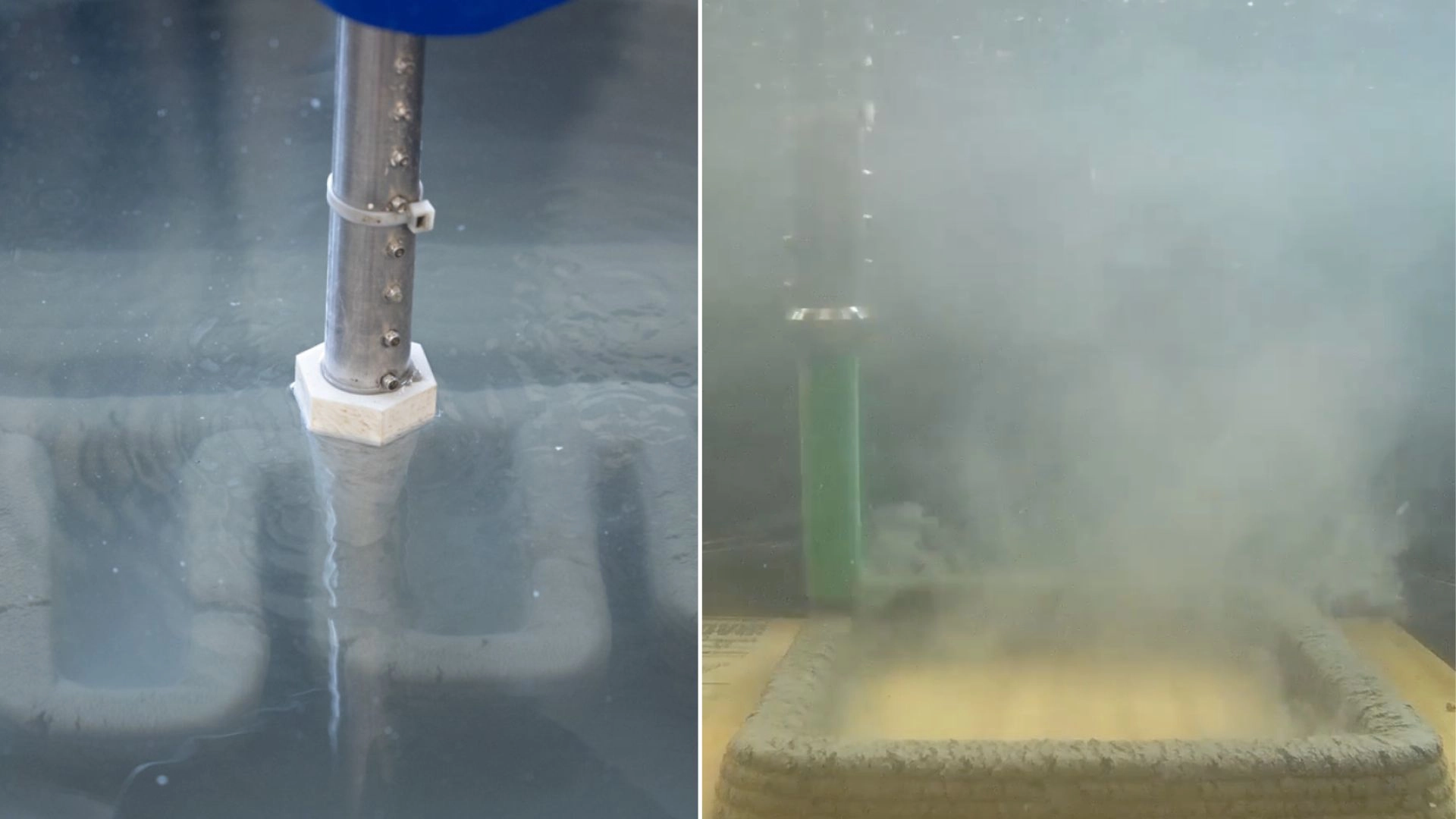
Researchers at Cornell University have made strides in underwater 3D printing technology, creating a method to print concrete directly beneath the ocean’s surface. This innovation emerged after the Defense Advanced Research Projects Agency (DARPA) initiated a challenge in late 2024 to find solutions for underwater concrete applications.
The aim is to address urgent needs related to repairing undersea cables and ports, crucial for global communication and trade. The Cornell team, led by Sriramya Nair, an assistant professor in civil and environmental engineering, is exploring ways to minimize environmental disruption and cut down construction time and costs. “We want to be constructing without being disruptive,” Nair explained, emphasizing the importance of using remotely operated vehicles to minimize ocean disturbance.
To adapt their existing 6,000-pound industrial robot for underwater use, the team modified their concrete mixture for stable underwater printing. This development is particularly innovative as it includes utilizing seafloor sediment as a primary material, significantly reducing the costs and logistics involved in transporting cement. In a demonstration in September 2025 to DARPA officials, the team showcased the feasibility of printing with ocean-floor materials, a process currently not practiced by others in the field.
One of the primary challenges they face is washout, where cement particles separate in water, compromising structural integrity. The team has to balance the viscosity caused by chemical additives used to mitigate this issue, impacting both printability and the ability to maintain the structure’s shape and bonding.
As they prepare for a competitive demonstration in March 2026, the team is also addressing technical challenges like visibility in murky waters due to fine sediments. They are working on sensors integrated with the robotic arm to monitor and adjust the printing process in real time without human divers being present.
This ambitious project combines expertise from various fields including materials science, robotics, architecture, and civil engineering, and seeks to redefine the future of construction in submerged environments.