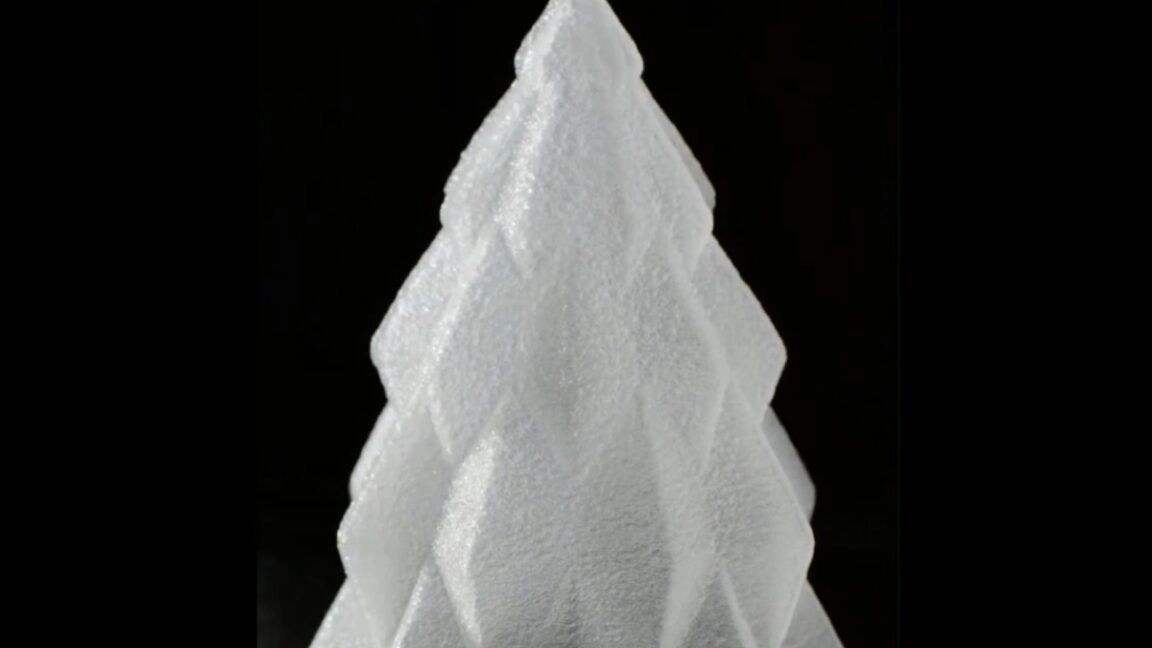
Physicists at the University of Amsterdam have developed an innovative way to create a miniature 3D-printed Christmas tree, measuring just 8 centimeters tall, using ice without any refrigeration technology. This groundbreaking technique relies on the principle of evaporative cooling, detailed in a recent preprint published on arXiv.
Evaporative cooling is a natural process commonly used by mammals for temperature regulation. An everyday example is seen when steam rises from a hot cup of coffee as the hotter water molecules escape. This principle is also responsible for phenomena such as “wine tears” and plays a role in various scientific applications, including the creation of Bose-Einstein condensates.
Typically, methods for ice printing depend on cryogenics or cooled surfaces. However, this new technique is the first to utilize evaporative cooling for 3D printing. The researchers conducted their experiments within a vacuum chamber, where they discovered that using a jet nozzle as the printing head eliminated air drag. They explained that at low pressure, water molecules escape from the liquid surface as vapor, which cools the water jet efficiently:
"Each departing molecule carries the latent heat of vaporization… making heat extraction very efficient."
As water is printed layer-by-layer onto a substrate or previously laid ice, it rapidly freezes upon impact, allowing the intricate structure to form.
An added benefit of this technique is that once the holiday season concludes, the printed ice tree can simply be melted away by turning off the vacuum, leaving no waste behind.
Beyond holiday decorations, the potential applications for this method are significant. The purity of the ice makes it suitable for biological uses, such as creating scaffolding for tissue engineering, where the ice can be cast into resin or polymer molds, leaving hollow channels upon melting. Additionally, this technique could support microfluidic applications or facilitate the construction of water ice structures on Mars, where similar cold and low-pressure conditions prevail.
For further details, refer to the preprint.