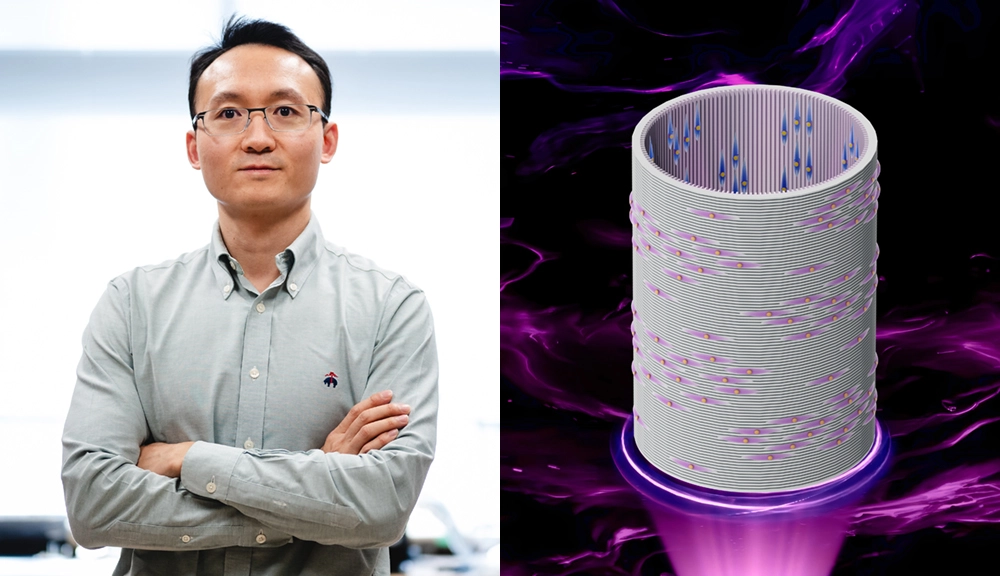
Yonghui Ding, a WPI researcher, has developed a groundbreaking method for creating 3D-printed scaffolds aimed at improving heart bypass grafts. This innovative approach could lead to significant advancements in the treatment of heart disease, which remains a leading public health crisis in the U.S.
The tiny biodegradable tubules Ding creates in his lab, measuring just 1 centimeter long and 2 to 3 millimeters in diameter, are vital to the potential regeneration of arteries rather than merely replacing them. The textured surface of these scaffolds helps guide cells to migrate and align properly, essential for forming healthy blood vessels.
In collaboration with researchers from Northwestern University, Ding’s team published their findings in Advanced Healthcare Materials, detailing their rapid 3D-printing process using biodegradable materials and light to forge these detailed tubules. The research shows promise for enhancing the effectiveness of coronary artery bypass grafting, a common procedure for restoring blood flow to the heart.
Ding emphasizes, "The goal of this research is to regenerate arteries, not just replace them." His work concentrates on creating grafts that can provide temporary structures for new tissue growth, allowing for a more natural regeneration process.
The novel multiscale microscopic 3D printing process known as MµCLIP enables the researchers to precisely fabricate layers of polymer, which are then cured to form flexible, biodegradable structures that support cell movement. In their experiments, they discovered that specially textured scaffolds significantly improved the movement and alignment of endothelial cells compared to smooth ones.
The implications of this research are profound, especially given the high demand for bypass surgeries. Ding expresses his hopes for the future of this technology: “Many people need bypass surgery, and our research could result in better grafts that lead to better health outcomes for patients.”
Ding, who joined WPI’s faculty in 2023, aims to leverage his expertise to push the boundaries of biomaterial design and manufacturing, ultimately contributing to more effective treatments for cardiovascular ailments.
For more information, you can explore the following resources: