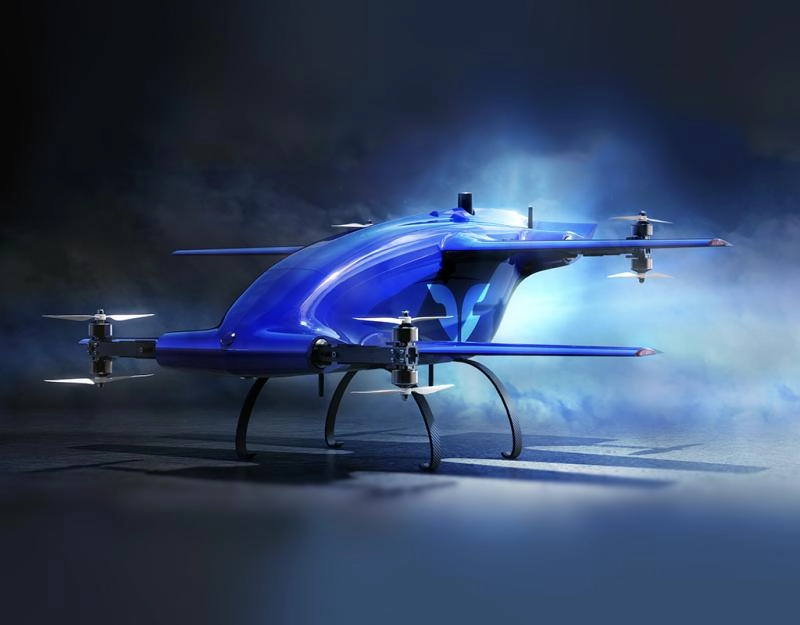
On August 19, 2024, drone logistics company Blueflite announced their new project, focusing on the development of hydrogen storage tanks specifically designed for unmanned aerial vehicles (UAVs). This effort has gained the support of the Northern Territory (NT) government and aims to produce a light yet robust high-pressure hydrogen vessel for UAVs needing extended range capabilities.
As part of this initiative, Blueflite is set to build a new facility in Darwin to craft these sophisticated hydrogen storage tanks. They will be using the Advanced Fiber Placement (AFP) technology, which utilizes the unique additive manufacturing resources available at Charles Darwin University (CDU). Notably, CDU is equipped with Australia’s only AFP-capable industrial robot, a significant upgrade from traditional methods used in composite vessel manufacturing. This technology will aid in fabricating more efficient and resilient hydrogen storage options.
Frank Noppel, the CEO of Blueflite, highlighted the project’s cooperative aspect by stating, “Together with CDU, H3 Dynamics, and the essential backing from the Northern Territory government, we plan to develop a composite hydrogen tank manufacturing capability currently unprecedented in Australia, and incorporate this into our established UAV platform.”
The adoption of hydrogen fuel cell technology in UAVs is poised to significantly revolutionize the field by enhancing the range and efficiency of these aerial vehicles. Hydrogen fuel cells could potentially increase the flight range of these drones by up to 700% over traditional lithium-ion batteries, making them perfectly suitable for extended-range operations.
CDU’s Energy Resource Institute will take part in this project by undertaking trials focused on hydrogen generation at remote locations and the refueling of storage systems produced locally. These hydrogen storage solutions will be incorporated into Blueflite’s UAVs, with their performance being tested at the Darwin UAV Flight Test Range.
This initiative is the tenth to be financially supported by the Advanced Manufacturing Ecosystem Fund (AMEF), which is overseen by the Advanced Manufacturing Growth Centre. The strategic aim of this partnership is to position the Northern Territory as a pioneer in both sustainable aviation and sophisticated manufacturing processes. As stated by Noppel, “Our vision at Blueflite and our Darwin collaborators is to amalgamate diverse skills and expertise to make the Northern Territory a benchmark in sustainable aviation and manufacturing, influencing multiple sectors and invigorating the economy of the Top End.”
In pioneering this innovative hydrogen storage technology, Blueflite is not only advancing UAV technology but is also fostering the adoption of sustainable energy across the aviation sector. The successful execution of this project promises to impact the UAV industry broadly as well as catalyze economic advancement in the Northern Territory.
This article highlights Blueflite’s commitment to innovation and sustainability, showcasing how advanced manufacturing techniques can lead to significant advancements in UAV technology and beyond.
Source: aumanufacturing.com.au
Hyliion has been awarded a Small Business Innovation Research (SBIR) government contract by the United States Navy. This contract marks the beginning of… read more »
6K Additive has been chosen by the RTX Technology Research Center (RTRC) and the University of Arizona to participate in the Environmental Additive… read more »
Shanghai Hanbang 3D Tech Co, Ltd (HBD) has declared a major breakthrough in the fabrication of turbine blades through additive manufacturing techniques.
Supernova, recently established as an independent entity from BCN3D in February, has revealed the formation of a new division focused on the progression of 3D technologies.
Jamplast, a leading resin distributor located in Ellisville, Missouri, has initiated an exciting new project with the start of 3DSHQ, a specialized business division.
Although the emphasis often lies on the latest developments in 3D printing technology, it is crucial to also recognize other important innovations within the broader technological spectrum.
Microalgae, like Odontella aurita and Tetraselmis striata, are becoming increasingly important as sources for sustainable materials in 3D laser printing applications.
Sandia National Laboratories, together with Wetzel Wind Energy Services and Stratasys Direct Inc., has developed a new design for turbine blade tips that promises enhanced performance.
ICON, along with Lennar, is nearing the completion of a development featuring 100 3D-printed homes in Texas, initiated in November 2022.
SPEE3D, a leader in the field of additive manufacturing, has recently entered into a significant partnership with RusselSmith, a top integrated energy solutions company in West Africa.