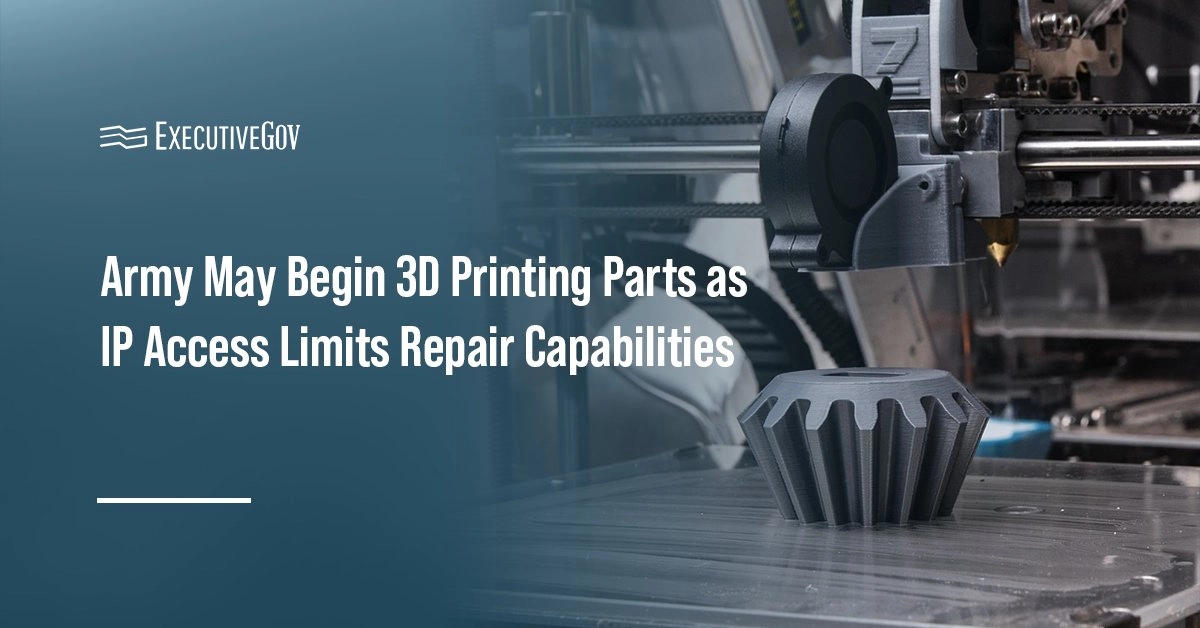
The U.S. Army is exploring the expansion of 3D printing technologies to produce replacement parts as it faces difficulties in accessing technical data owned by contractors. Lt. Gen. Christopher Mohan, acting commander of Army Materiel Command, highlighted the challenges posed by reliance on contractor intellectual property, which has hindered repair and maintenance processes for critical systems. During an Association of the U.S. Army conference, Mohan indicated that the Army might begin producing parts independently due to the urgent need for repairs.
Mohan recounted a specific incident where a vehicle became inoperable due to a faulty tire valve, and the Army’s attempts to replicate the part were thwarted by technical data that was only available from a subcontractor far removed from the prime contractor. He suggested that a more efficient model could allow the Army to purchase rights specifically for the parts it needs rather than acquiring data for entire systems.
To expedite production and alleviate supply chain delays, the Army has been assessing additive manufacturing capabilities and plans to 3D print 60 components in 60 days, which would substantially reduce production times compared to conventional methods.
The Army is also establishing a digital parts repository that enables soldiers to access and print basic, non-sensitive items directly in the field. Mohan noted that soldiers have successfully utilized tactical networks to download parts from this repository and print them using mobile setups, although improvements to the system are still needed.
Army Secretary Dan Driscoll has emphasized the significance of this initiative, pointing to a practical example where the Army manufactured a fin for a Black Hawk external fuel tank for about $3,000, compared to the vendor’s price of $14,000. The Army’s in-house version was noted to be stronger and significantly cheaper.
Moreover, Driscoll has implemented a new policy granting soldiers greater autonomy for field repairs based on risk assessment. Low-risk repairs can be authorized immediately, whereas higher-risk fixes will require additional scrutiny. This policy represents a significant shift from the previous practice that often necessitated high-level approvals for even minor repairs.
With these initiatives, the Army aims to enhance its operational effectiveness and reduce downtime by leveraging modern manufacturing technologies and adapting its internal processes to support rapid repairs in critical situations.