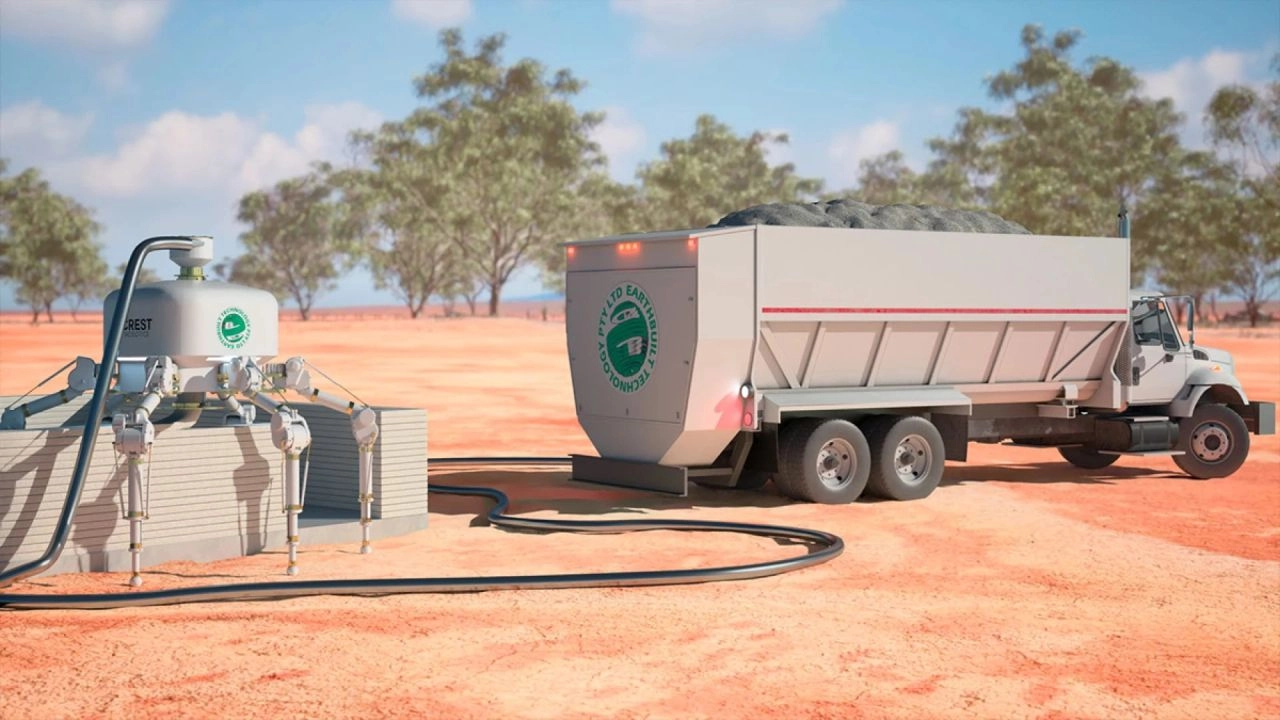
3D printing is revolutionizing the construction industry, showcasing its potential to build homes rapidly and efficiently. A notable advancement comes from an Australian startup, Crest Robotics, which has developed a spider-like construction robot named Charlotte. This innovative robot is capable of 3D printing a 200-square-meter home in just one day.
Collaborating with Earthbuilt Technology and receiving support from the NSW Government, the project aims not only to provide affordable housing solutions on Earth but also to further lunar exploration technologies. The robot is engineered with a large form-factor extrusion system that enables it to gather local materials like sand, earth, and recycled products such as crushed brick. These materials are then utilized to form building layers, all executed by the robot’s automated processes.
Founder Dr. Clyde Webster explained that Charlotte operates on a sustainable construction principle, reminiscent of Earthbagging, where loose materials are packed into tubes or bags to create sturdy walls. This traditional method is labor-intensive, but with the efficiency of Charlotte, construction can be expedited, thus enhancing worker safety as well.
The robot’s capabilities were highlighted in an introductory video that depicts it deploying from a spacecraft, showcasing its ability to print structures layer by layer, akin to established 3D printing firms like ICON and COBOD.
In addition to solving labor shortages, Crest Robotics envisions a future where this technology modernizes infrastructure with safe and efficient methods. The Charlotte robot is still in the development phase, but an initial prototype has already been displayed at the 76th International Astronautical Congress in Sydney.
By merging advanced technology with practical applications, Charlotte symbolizes a significant leap forward in the quest for innovative construction solutions.
For more information on this evolving technology, you can check Crest Robotics’ official site and explore similar advancements in 3D-printed architecture.