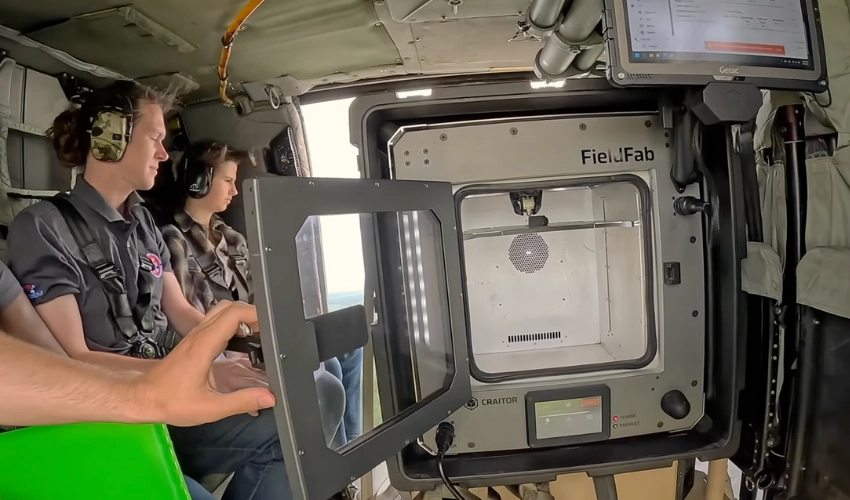
The Indiana Army National Guard has made a significant advancement in military technology by successfully demonstrating 3D printing aboard a UH-60 Black Hawk helicopter. This breakthrough highlights a growing trend in the defense sector toward adopting additive manufacturing methods.
During a recent mission, troops utilized a FieldFab Expeditionary 3D Printer developed by Craitor Inc. This specialized printer is designed to withstand the challenges of flying, including air turbulence, variable temperatures, and the physical stress of flight. The 3D printer was actively producing components for unmanned aerial systems (UAS) while the helicopter was performing tactical maneuvers.
Powering the printer was a METEOR Quiet Tactical Power solution by Sentient Industries, a portable energy source well-suited for rigorous field operations. This setup ensured the printer functioned seamlessly throughout the flight. The successful use of additive manufacturing in such a dynamic environment underscores major technological advancements in portability and durability.
Military leaders assert that this trial goes beyond mere novelty. It suggests a paradigm shift in how military operations are sustained. Traditionally, supply chains can hinder mission progress due to delays in receiving replacement parts or specialized equipment. By enabling the printing of parts mid-flight, soldiers can reduce their reliance on distant supply sources, thereby allowing for real-time responses to emerging challenges. This capability means that troops could carry production systems with them, enhancing their adaptability in contested areas.
Eric Shnell, CEO of Craitor Inc., emphasized the transformative potential of this capability, stating, “This demonstration is about more than printing parts in the air; it’s about transforming how the military can sustain combat power.” His insights suggest that producing precise components on demand would significantly minimize downtime, enhance operational readiness, and provide unprecedented flexibility to military forces.
Lieutenant Colonel Matthew Limeberry, commander of the Rapid Assessment of Prototype Technology Readiness Task Force, indicated that this initiative is just the beginning. He noted, “We are moving promising technologies out of the lab and into the hands of soldiers,” asserting that innovations such as airborne 3D printing could redefine combat support capabilities.
The success of this demonstration points to how quickly commercial technologies can be adapted for military use, paving the way for enhanced agility within the U.S. military.
For more information on this development, visit 3D printing technologies and aerospace and defense 3D printing.