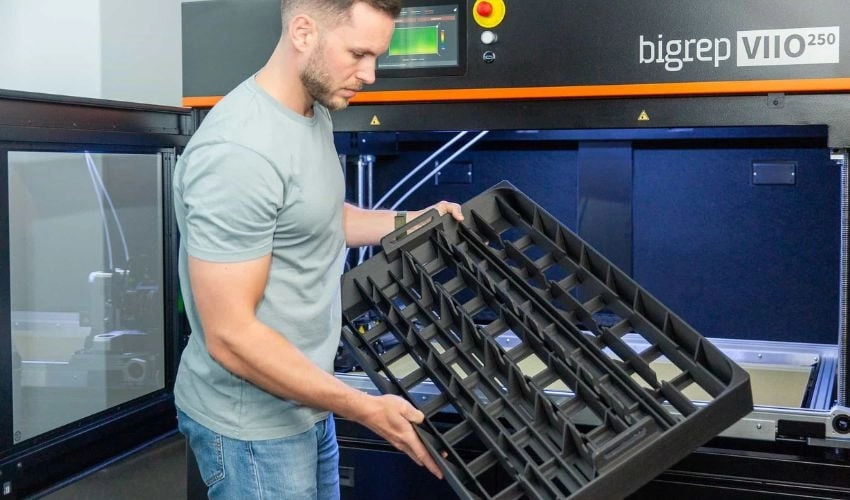
In the automotive sector, manufacturers often encounter challenges, notably lengthy supply chains that can cause significant delays, disrupting the entire production process. With the increasing demand for speed and performance, such delays can have serious implications. Additive manufacturing emerges as a reliable solution, providing a consistent production process that many companies are beginning to adopt. One such company is Automotive Entertainment, located in Southern California, which has embraced BigRep’s large-format 3D printing technology to create custom automotive parts tailored to specific consumer requests, such as center consoles and custom brackets.
As the industry transitions from prototyping to the production of finished components, 3D technologies are proving valuable. This shift highlights the importance of customization for consumers seeking unique vehicles. A study by Straits Research predicts that the global automotive aftermarket will reach $70 billion by 2029, propelled by the demand for personalized options, lighter components, and innovative materials.
Automotive Entertainment specializes in high-end vehicle modifications, aiming to meet each customer’s unique specifications for speed, design, and cost-effectiveness. Thus, they recognized the need for a manufacturing method that would enable rapid production of appealing and customized parts. Additive manufacturing positioned itself as the clear answer.
The choice to utilize BigRep 3D printers stemmed from their ample print volume, which allows for the fabrication of large parts without the need for assembly from smaller pieces, ensuring enhanced efficiency and durability. Initially employing a BigRep STUDIO, the company upgraded to the BigRep VIIO 250 in 2024, impressed by the consistent quality it delivered. The VIIO 250’s print volume of 1000 x 500 x 500 mm, along with two Smart Manufacturing extruders, supports automated, reliable production.
Owner JT Torres commented, “The BigRep VIIO 250 allows us to produce large-scale, high-precision parts. Our material of choice is HI-TEMP filament, which offers the strength, durability, and dimensional stability required for custom automotive components. It allows us to prototype and produce everything from custom speaker enclosures to dash panels and trim pieces, all with the structural integrity required for real-world automotive use.”
Furthermore, integrating large-scale additive manufacturing has transformed the company’s workflow, allowing them to depend on an in-house production system rather than relying on external mold manufacturers. This shift significantly reduces lead times; Automotive Entertainment can now produce prototypes or finished parts within the same day. Torres noted, "On a recent project, we saved more than two weeks on panel manufacturing alone. We estimate savings of 40 to 50% in terms of costs, considering labor and materials."
The process of producing speaker enclosures has also benefited. Traditionally, this involved messy fiberglass mold procedures, but with 3D scanning, a digital model of the enclosure can be directly created for 3D printing, enabling precise and cleaner production practices. This modern approach allows for quicker and more consistent audio installation customizations.
The evolution of 3D printing is reshaping how automotive parts are manufactured, customized, and distributed. By enabling on-demand production closer to customers, additive manufacturing empowers companies to respond more swiftly to market demands for personalization, sustainability, and rapid delivery.
BigRep continues to provide automotive innovators with the tools necessary for efficient and fast progress, symbolizing a promising future where innovation is printed. For more insights and technical explanations, you might visit the BigRep blog.