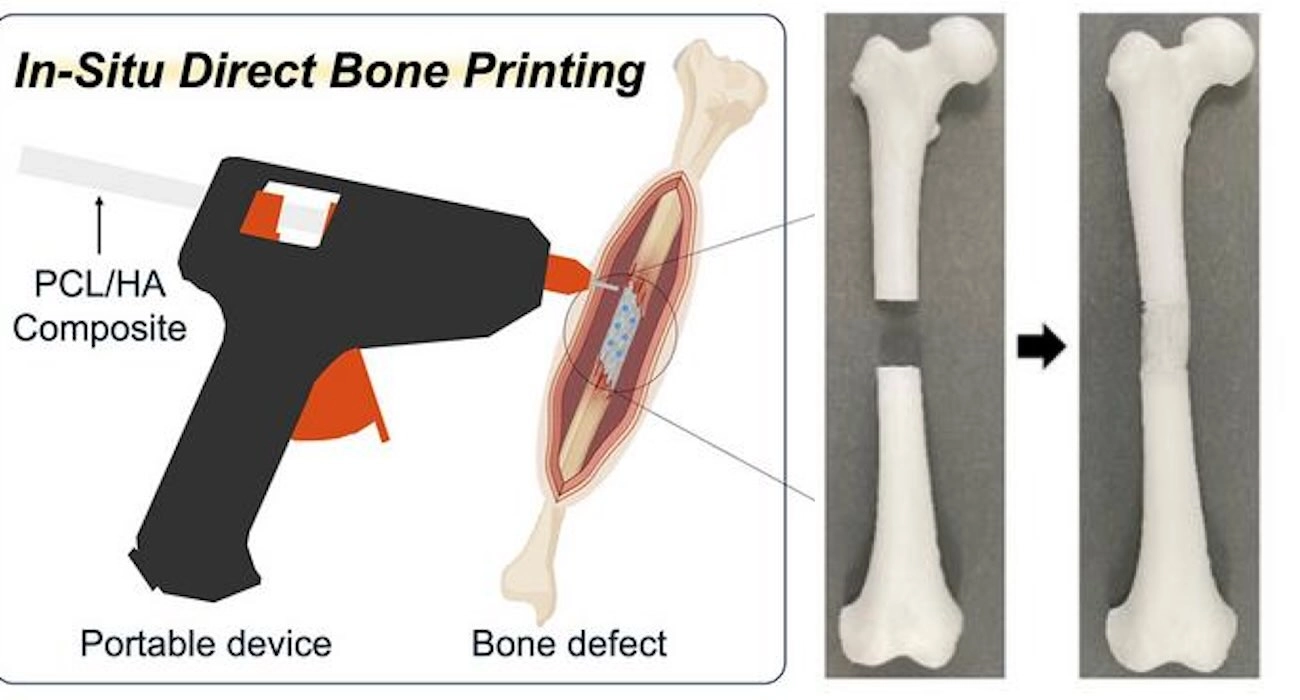
A groundbreaking innovation in the medical field has emerged with the development of a 3D printing “glue gun” designed to create bone grafts directly onto fractures during surgery. Researchers from South Korea have created this tool to address the challenges associated with traditional bone grafts, which often require advanced preparation and fitting before surgery.
The newly designed glue gun allows surgeons to fabricate and apply bone implants in real-time at the surgical site. This approach eliminates prior procedures such as imaging and modeling, facilitating a more direct and tailored response to complex fractures. The technology behind the glue gun incorporates a filament composed of hydroxyapatite (HA), a natural bone component that promotes healing, and polycaprolactone (PCL), a biocompatible thermoplastic.
What’s innovative about this system is its ability to conform to the jagged edges of fractures while remaining cool enough to prevent damage to surrounding tissues. This capability enables the creation of customized grafts tailored to the specific anatomical requirements of each patient. By adjusting the HA and PCL ratio in the filament, the researchers can control various properties of the grafts, such as hardness and strength.
To combat infection—an ongoing concern with surgical implants—the researchers infused the filament with antibiotics that are slowly released at the surgical site for several weeks. This method not only targets potential infections effectively but also minimizes side effects associated with systemic antibiotic use.
In laboratory tests conducted on rabbits with severe femoral fractures, the new method showed remarkable success, with no signs of infection or tissue death observed after 12 weeks post-surgery. The 3D-printed grafts facilitated superior bone healing compared to traditional bone cement, suggesting a significant advancement in bone regeneration techniques.
As the researchers optimize the antibacterial properties of this system, they are preparing to initiate human trials. The goal is to bring this innovative technology into real-world surgical settings, aiming to make significant contributions to bone repair and surgery efficiency.
For more details, see the original research published in the journal Device.