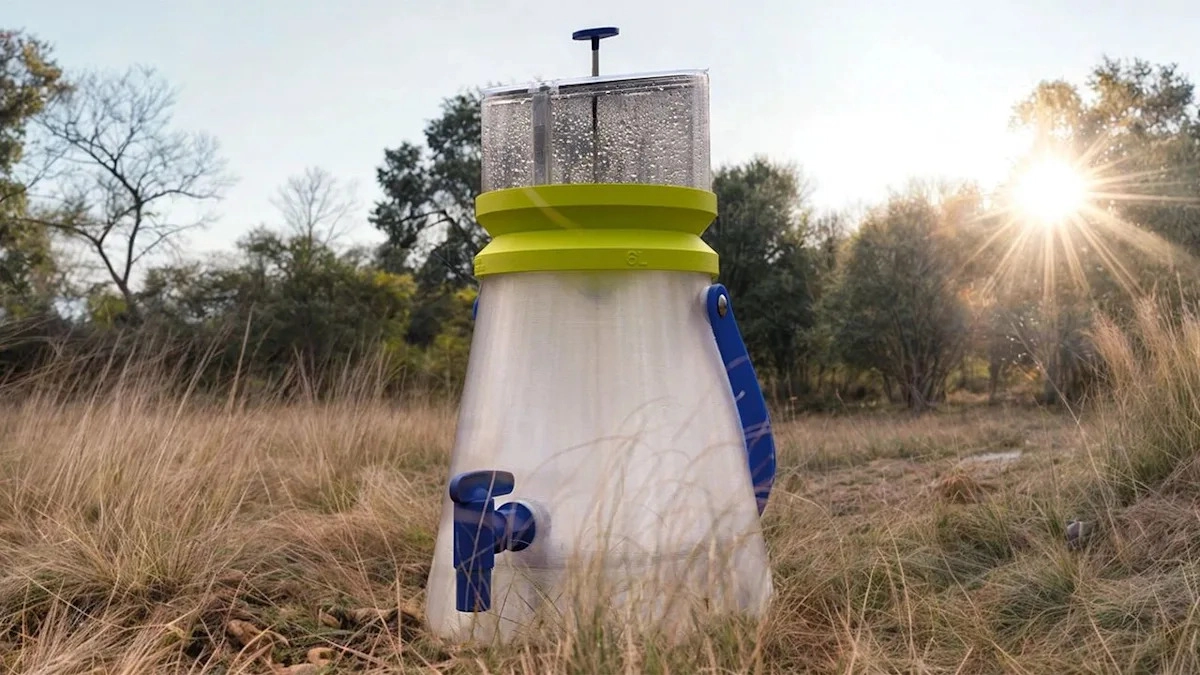
Two university graduates have created an innovative portable device that can generate approximately six liters (around 1.6 gallons) of drinking water daily from atmospheric moisture, using advanced 3D printing technology. This project, called Water from Air, aims to tackle the critical issue of water scarcity affecting billions around the globe.
Louisa Graupe and Julika Schwarz, the minds behind the project, drew their inspiration from the alarming statistics suggested by the World Economic Forum, which indicate that around 72% of the world’s population faces various levels of water insecurity, with 8% experiencing severe shortages. Existing atmospheric water collection systems tend to be complex, expensive, and technically challenging, underscoring the necessity for more accessible solutions.
Their device utilizes a technique known as atmospheric water generation (AWG) to condense water from the air. It employs 3D-printed components made from materials like transparent Polyethylene Terephthalate Glycol (PETG) and features a lid produced through stereolithography. However, it relies on “metal-organic frameworks” — porous materials functioning as microscopic sponges that attract water molecules. The process involves drawing in humidity when the top is open and then trapping the water through condensation when closed.
The device is designed to function effectively, achieving up to 12 condensation cycles each day, allowing for 500 ml (~17 ounces) of water to be collected every two hours. With a daily output sufficient to support a family of four, this invention could play a significant role in improving hydration for those in water-scarce environments.
Although still in the prototype phase, Graupe and Schwarz envision a future where such devices could be scaled up to serve entire communities. The project’s use of 3D printing not only facilitates rapid prototyping but also enhances modularity for easy maintenance and repair, potentially empowering widespread adoption of their design.